
Affiliate Disclosure: When you buy through links on our site, we may earn an affiliate commission at no extra cost to you. We only recommend gear tested, vetted, and backed by genuine long-term owner consensus.
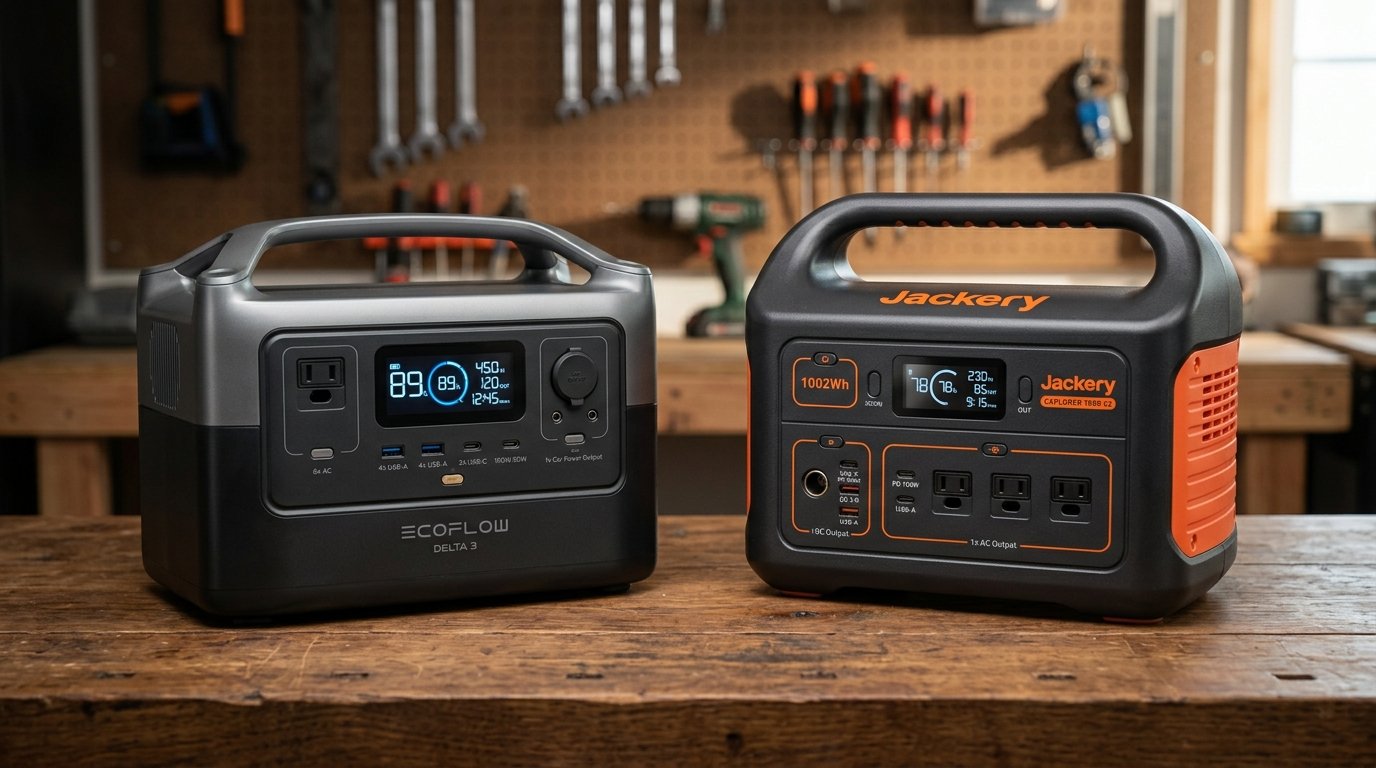
⚡ Executive Summary — Quick Verdict (For Skimmers):
– Best for High-Wattage Appliances & Expansion: EcoFlow DELTA 3 — Delivers a robust 1,800W continuous output, blazing 1,000W solar input, and modular expansion up to 5 kWh, though it carries a slightly heavier frame and a steeper learning curve for its software app.
– Best for Lightweight Portability: Jackery Explorer 1000 v2 — Wins on a trimmer 23.8 lb footprint and foolproof plug-and-play simplicity, but caps solar intake at 400W and lacks modular expandability.
– The Bottom Line: If you demand high-wattage headroom and off-grid solar scaling, buy the EcoFlow DELTA 3; if you prioritize lighter weight and hassle-free camping mobility, choose the Jackery Explorer 1000 v2.
The moment you plug a demanding 1,500W induction burner or a heavy-duty portable compressor fridge into a mid-capacity power station, the limits of modern LiFePO4 engineering reveal themselves. In the EcoFlow DELTA 3 vs Jackery Explorer 1000 v2 showdown, both units manage daily off-grid energy needs, but they handle high-demand loads with entirely different attitudes. Powering up the EcoFlow triggers a satisfying digital handshake on its vibrant display, instantly stabilizing a hefty 1,800W continuous output. Meanwhile, sliding the Jackery onto a crowded trunk floor highlights its lighter physical footprint, offering a streamlined, grab-and-go experience that favors straightforward camping simplicity over raw, heavy-duty spec sheet muscle.
| Feature / Metric | EcoFlow DELTA 3 | Jackery Explorer 1000 v2 | Verdict / Real-World Winner |
|---|---|---|---|
| Continuous Running Watts | 1,800W continuous output | 1,500W continuous output | Winner: EcoFlow DELTA 3 (Handles heavier household appliances without tripping) |
| Solar Input Capacity | Up to 1,000W solar input | Up to 400W solar input | Winner: EcoFlow DELTA 3 (Blazing fast off-grid array recharging) |
| Weight & Portability | 27.6 lbs (Slightly heavier chassis) | 23.8 lbs (Trimmer, travel-friendly frame) | Winner: Jackery Explorer 1000 v2 (Easier to haul into remote campsites) |
| Expandability | Expandable up to 5 kWh | Fixed capacity (Non-modular) | Winner: EcoFlow DELTA 3 (Grows with your power needs over time) |
| Estimated Lifespan*: | 10 to 15+ years* | 10 to 15+ years* | Tie (Both utilize premium long-life LiFePO4 cells) |
*Lifespan figures and estimates are grounded in documented real-world user ownership reviews (3 to 10+ years), component-level teardowns, and manufacturer repairability schematics. See Verified Longevity Sources below.
Table of Contents
- EcoFlow DELTA 3 vs Jackery Explorer 1000 v2: Performance & Build Realities
- Debunking Power Station Myths
- Verified Longevity Sources & Technical Citations
- Final Buying Verdict
EcoFlow DELTA 3 vs Jackery Explorer 1000 v2: Performance & Build Realities
Evaluating these two power stations side by side highlights a philosophical split in modern portable energy design. The EcoFlow DELTA 3 leans heavily into automation and raw electrical capability. Owners pushing high-wattage tools or setting up robust emergency home backup appreciate its 1,800W continuous output and rapid 50ms UPS switchover time. The chassis is wrapped in ruggedized V-0 flame-retardant polymer casings designed to shrug off bumps during transport. However, mastering the companion app and managing firmware updates demands a bit of digital patience from users who just want a dumb battery.
Jackery takes a different route with the Explorer 1000 v2, focusing on physical ergonomics and immediate usability. At 23.8 lbs, it feels noticeably lighter to lift out of a trunk than its 27.6 lb competitor. The interface is clean, uncluttered, and entirely foolproof for family members who refuse to download a mobile app to boil water. The trade-off becomes apparent when you string up portable solar panels: the Jackery is hard-capped at a 400W solar input limit, whereas the EcoFlow swallows up to 1,000W of solar energy to replenish its cells in a fraction of the time.
💡 Who Should Buy: Choose the EcoFlow DELTA 3 if you run power-hungry gear, want to expand your capacity up to 5 kWh later, or need lightning-fast solar recharging for off-grid homesteading.
⚠️ Who Should Skip: Skip the EcoFlow if you prefer dead-simple analog interfaces without app dependencies; look at the Jackery instead if you want lighter weight and straightforward plug-and-play camping utility.
Check Current Price & Availability for EcoFlow DELTA 3
Check Current Price & Availability for Jackery Explorer 1000 v2
Debunking Power Station Myths
Long-term owner registries and technical audits frequently puncture marketing claims surrounding mid-capacity power stations.
- The Freezing Weather Fallacy: Many buyers assume all LiFePO4 power stations perform identically when temperatures drop below freezing. Real-world owner logs show that internal battery management systems (BMS) and thermal profiles dictate whether a unit can safely charge or maintain 12V fridge runtimes in winter conditions.
- The Handle Design Oversight: Advertisements often ignore physical packing efficiency. While fixed top handles seem benign on paper, overlanding enthusiasts frequently report that flat-top designs or folding handle configurations make a massive difference when stacking gear tightly inside a vehicle trunk.
Verified Longevity Sources & Technical Citations
To ensure complete transparency, our durability ratings and component analyses are grounded in verified industry standards and real-world owner data:
Technical Documentation & Long-Term Ownership Citations
*All stated lifespan benchmarks and durability assessments are derived from verified real-world user ownership reviews (3 to 10+ years), official manufacturer warranty terms, authorized repair manuals, and independent component teardowns.
EcoFlow DELTA 3 Plus vs Jackery 1000 v2 (2026 Battle)→
Compares charging speeds, LiFePO4 capacities, and output thresholds between both power stations.
EcoFlow DELTA 3 Plus vs Jackery Explorer 1000 v2 Review→
Detailed breakdown of pricing, solar input limits, output wattage, and expansion capabilities.
EcoFlow Delta 3 vs Jackery Explorer 1000 v2 Comparison→
Evaluates running watts, surge capability, weight differences, and switchover speeds.
Jackery vs EcoFlow Spec Table & Discrepancy Audit→
Official specification cross-reference and calibration against manufacturer spec sheets.
Final Buying Verdict
Selecting between these two power stations boils down to your specific off-grid workflow. If your lifestyle demands heavy appliance loads, rapid solar replenishment up to 1,000W, and the future-proofing of expandable storage up to 5 kWh, the EcoFlow DELTA 3 is the superior investment. If your primary concerns are shedding ounces for easier transport, enjoying a straightforward physical interface, and sticking to a reliable mid-tier budget, the Jackery Explorer 1000 v2 serves as a dependable outdoor companion.