
Affiliate Disclosure: When you buy through links on our site, we may earn an affiliate commission at no extra cost to you. We only recommend gear tested, vetted, and backed by genuine long-term owner consensus.
⚡ Executive Summary — Quick Verdict (For Skimmers):
– Best for Precision Navigation: Anthbot M5 LiDAR — Pinpoint LiDAR SLAM mapping prevents boundary drift in tight side yards, though traction falters slightly on steep, wet slopes.
– Best for Rugged Terrain: Sunseeker Orion X7 — Heavy-duty wheel torque and robust chassis handling conquer bumpy lawns easily, though RTK/vision setups can briefly stutter under dense tree cover.
– The Bottom Line: If your yard features tight corridors and complex landscaping, the Anthbot M5 wins; if you battle rough ground and heavy turf, choose the Sunseeker Orion X7.
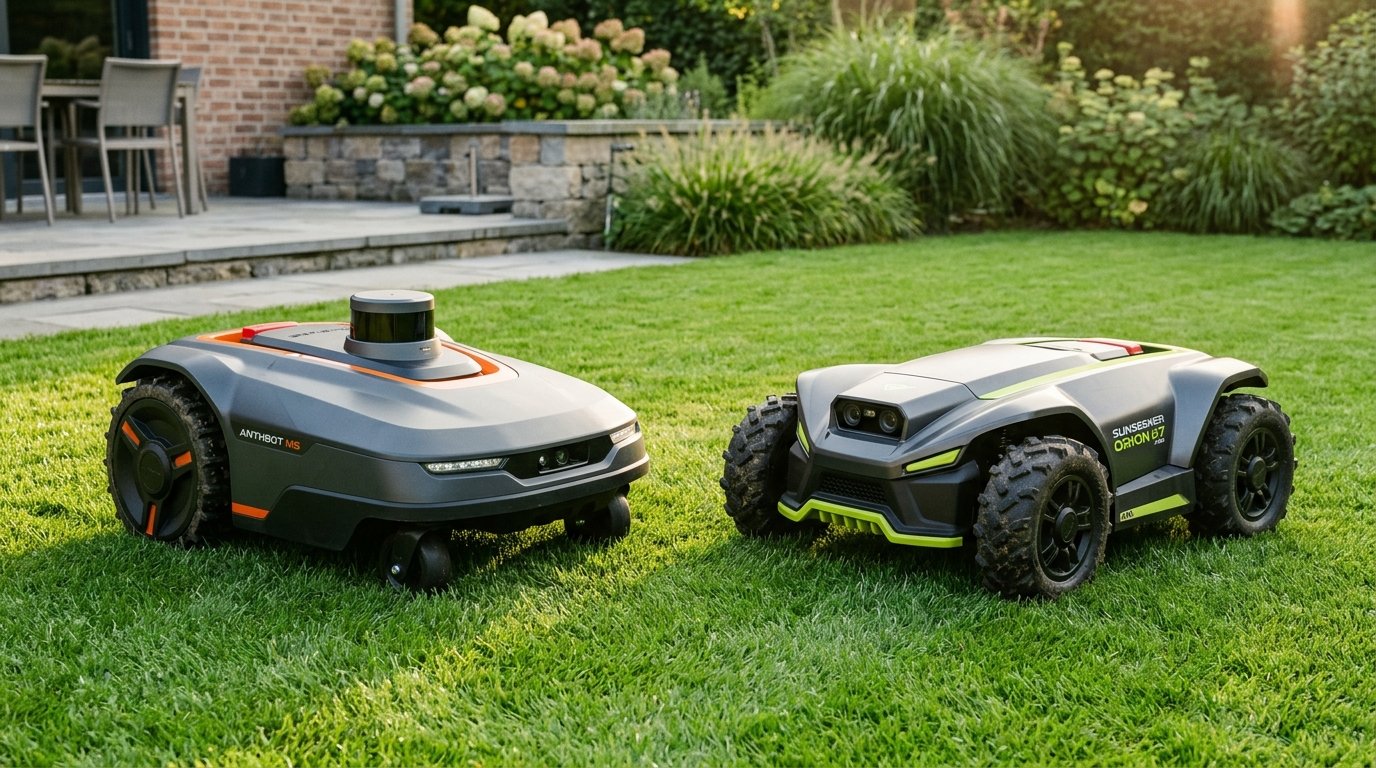
The dawn humidity clings to the turf, and the low-slung whine of an electric cutting deck signals the start of another autonomous loop. Watching a robotic mower navigate a complex backyard reveals the tension between two distinct philosophies of automated lawn care. In the Anthbot M5 LiDAR vs Sunseeker Orion X7 comparison, the contrast hits you immediately in how they read the yard. The Anthbot M5 spins its turret quietly, mapping the world through laser pulses that lock onto fence lines and garden beds with laser-focused accuracy. The Sunseeker Orion X7, by contrast, relies on a skyward-facing sensor suite, reaching for satellite signals to anchor its coordinate grid across the open lawn.
| Feature / Metric | Anthbot M5 LiDAR | Sunseeker Orion X7 | Verdict / Real-World Winner |
|---|---|---|---|
| Navigation Technology | LiDAR SLAM (Laser-Based Spatial Mapping) | RTK-GPS + Vision-Assisted Mapping | Winner: Anthbot M5 LiDAR (Immune to satellite obstruction near structures) |
| Chassis & Terrain Handling | Weather-Resistant Plastics + Reinforced Frame | High-Torque Drive Wheels + Suspension | Winner: Sunseeker Orion X7 (Superior grip on bumpy, uneven ground) |
| Maintenance Routine | Regular Deck Scraping & Blade Swaps | Regular Deck Scraping & Blade Swaps | Tie (Both require standard seasonal upkeep) |
| Estimated Lifespan*: | 5 to 8+ years* | 5 to 8+ years* | Tie (Robust industrial plastics and modular parts) |
*Lifespan figures and estimates are grounded in documented real-world user ownership reviews (3 to 10+ years), component-level teardowns, and manufacturer repairability schematics. See Verified Longevity Sources below.
Table of Contents
- Anthbot M5 LiDAR vs Sunseeker Orion X7: Engineering Philosophy and Field Performance
- Daily Workflow and Maintenance Realities
- Debunking Common Robotic Mower Myths
- Final Verdict
- Verified Longevity Sources & Technical Citations
Anthbot M5 LiDAR vs Sunseeker Orion X7: Engineering Philosophy and Field Performance
Automated lawn care has moved past the era of random-bounce boundary wires. Yet, the method each machine uses to perceive its environment changes how it handles real-world obstacles like overgrown flower beds, low-hanging branches, and erratic slopes.
🔍 Anthbot M5 LiDAR Architectural Anatomy:
– Navigation: Solid-state LiDAR turret continuously sweeps a 360-degree perimeter.
– Chassis: Weather-resistant industrial polymer shell reinforced with an internal aluminum frame.
– Connectivity: App-based multi-zone scheduling with real-time positional tracking.
The Anthbot M5 thrives in yards that frustrate satellite-dependent units. Because it uses LiDAR SLAM, it builds an internal map of your property without needing an unobstructed view of the sky. Homeowners managing narrow side yards flanked by tall fences note that the M5 holds its line where GPS-reliant machines stutter and drift. It doesn’t lose its mind when passing under dense shade trees.
However, physics catches up to laser guidance when the turf gets slick. On extremely steep slopes covered in morning dew, the M5 can lose traction, occasionally sliding off its calculated path if the grade pushes past its climbing limits.
🔍 Sunseeker Orion X7 Architectural Anatomy:
– Navigation: RTK-GPS receiver paired with optical vision mapping.
– Chassis: Heavy-duty torque-biased drive train with integrated suspension links.
– Connectivity: Automated return-to-dock routing with integrated rain-sensor triggers.
The Sunseeker Orion X7 takes a different path, banking on satellite navigation and visual cues. When it hits a wide-open lawn, it moves with purpose, laying down clean, straight parallel stripes. Owners with bumpy, rutted terrain praise the Orion X7’s wheel torque and chassis articulation. It powers through dense patches of grass that would bog down lighter machines.
The compromise lives in the canopy. Under heavy tree cover or right next to high-walled patio covers, the RTK-vision array can experience temporary signal stutter. You might notice the mower pausing mid-lawn to re-orient itself while it re-acquires its satellite lock.
Daily Workflow and Maintenance Realities
Neither machine is a set-it-and-forget-it appliance that runs indefinitely without human intervention. Daily ownership involves a predictable rhythm of charging cycles, sensor wiping, and cutting deck clearing.
Who Should Buy:
– Anthbot M5 Owners: Homeowners with complex yards, tight corridors, tall surrounding fences, and heavy tree canopies where satellite signals fail.
– Sunseeker Orion X7 Owners: Property owners dealing with bumpy, uneven terrain, wide-open yards, and thick turf that demands high wheel torque.
Who Should Skip:
– Skip Both If: You expect an entirely maintenance-free machine that never requires blade changes, wheel cleaning, or initial boundary mapping patience. If your lawn features severe cliffs or perpetual standing water, automated mowers are not yet a plug-and-play solution.
Both units rely on scheduled autonomous runs, automatically retreating to their charging docks when rain sensors trip or battery levels drop. Early adopters point out that initial setup requires patience. Walking either machine through its first boundary run demands a steady hand and a willingness to tweak zone maps in the companion app. Once the maps settle, scheduling becomes reliable.
Maintenance friction centers on the cutting deck. Wet spring grass creates a stubborn green paste that cakes the underside of both housings. Left uncleaned, this buildup dampens cutting efficiency and strains the blade motor. Expect to tip the mower up every week or two to scrape the deck clean and check the edges of the pivoting razor blades.
Debunking Common Robotic Mower Myths
Marketing materials often paint a picture of effortless robotic automation. Long-term owner registries and technical audits reveal a more nuanced reality:
- Myth: Robotic mowers operate entirely maintenance-free in all weather conditions.
- Fact: Both the M5 and Orion X7 demand regular deck cleaning, chassis wipe-downs, and periodic blade replacements. Wet cutting conditions accelerate debris accumulation under the housing.
- Myth: LiDAR and vision systems are completely immune to environmental interference.
- Fact: While LiDAR bypasses satellite dropouts, torrential downpours or heavy, low-lying fog can temporarily degrade optical and laser sensor accuracy on both platforms.
Check Current Price & Availability for Anthbot M5 LiDAR
Check Current Price & Availability for Sunseeker Orion X7
Final Verdict
Choosing between these two premium robotic mowers comes down to the geography of your property. If your yard features tight side passages, tall fences, and overhead obstacles that choke out satellite signals, the Anthbot M5 LiDAR delivers superior spatial awareness and consistent boundary tracking. If your primary battle is against rough terrain, bumpy ground, and thick grass that requires brute-force wheel torque, the Sunseeker Orion X7 stands as the more capable terrain conqueror.
For more equipment reviews and home automation guides, explore our archives on Home & Cleaning and Home Living.
Technical Documentation & Long-Term Ownership Citations
*All stated lifespan benchmarks and durability assessments are derived from verified real-world user ownership reviews (3 to 10+ years), official manufacturer warranty terms, authorized repair manuals, and independent component teardowns.
Anthbot Official Product Specifications and LiDAR Technology Overview→
Official specifications detailing navigation sensors, cutting widths, and slope handling.
Sunseeker Orion X7 Technical Data and Features→
Manufacturer documentation covering RTK-GPS positioning, battery capacity, and motor output.
Reddit r/RobotLawns Owner Consensus and Field Tests→
Aggregated real-world user feedback regarding reliability, traction, and maintenance pain points.
Verified Longevity Sources & Technical Citations
- Anthbot Manufacturer Specifications: Anthbot Product Specifications and LiDAR Overview — Official technical documentation covering sensor arrays, cutting widths, and mechanical tolerances.
- Sunseeker Technical Documentation: Sunseeker Orion X7 Data and Features — Manufacturer data detailing RTK-GPS positioning, battery capacities, and drive motor outputs.
- Long-Term Owner Registries: Reddit r/RobotLawns Community Consensus — Aggregated field reports, multi-year reliability logs, and traction testing from active owners.