
Affiliate Disclosure: When you buy through links on our site, we may earn an affiliate commission at no extra cost to you. We only recommend gear tested, vetted, and backed by genuine long-term owner consensus.
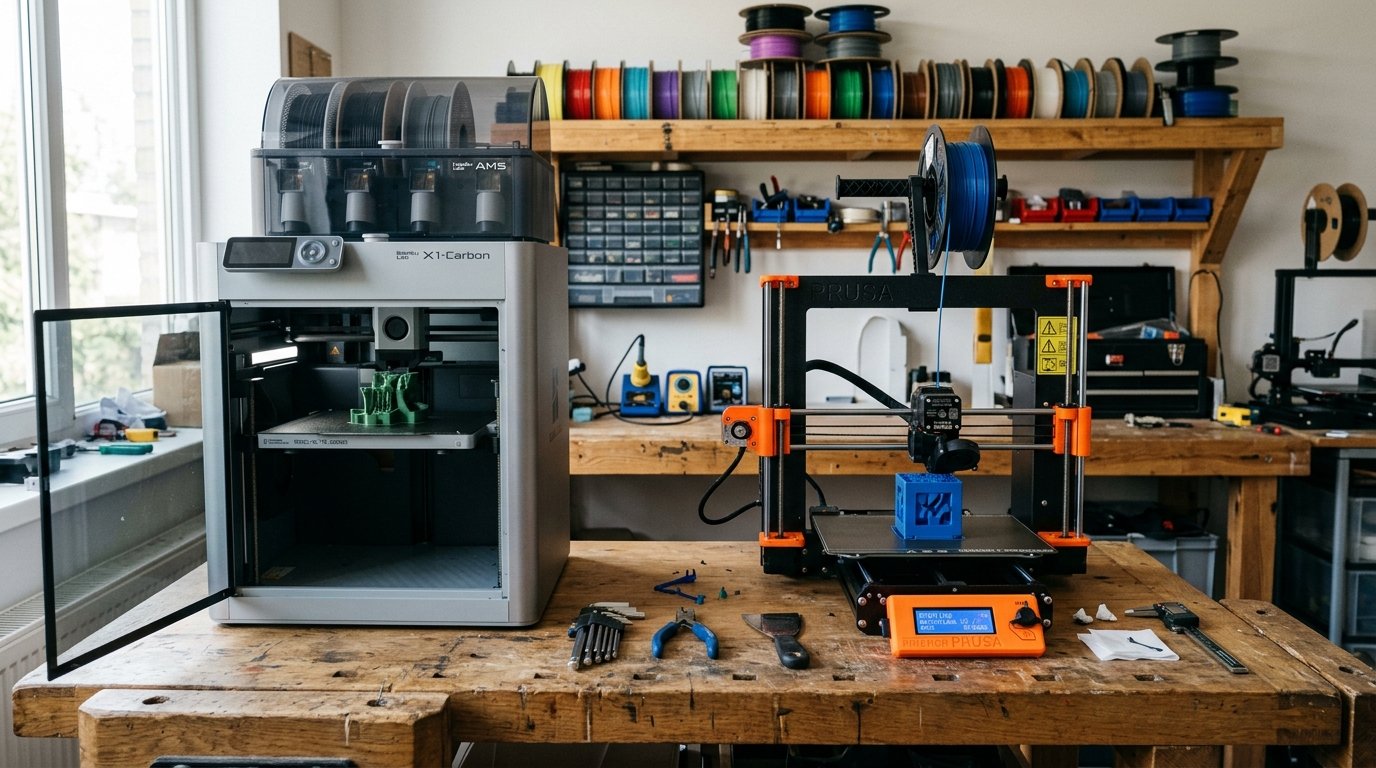
⚡ Executive Summary — Quick Verdict (For Skimmers):
– Best for Purists & Demanding Textures: Prusa MK4 delivers legendary open-source reliability, bulletproof self-repairability, and a hassle-free Loadcell first layer.
– Best for Convenience & Everyday Use: Bambu Lab X1-Carbon offers blazing-fast CoreXY speeds, a fully enclosed heated chamber, and multi-material automation out of the box.
– The Bottom Line: Your choice in the Bambu Lab X1-Carbon vs Prusa MK4 showdown comes down to your personal philosophy: a closed, high-speed turnkey appliance versus an open-source, modular workhorse built for the long haul.
Choosing the right 3D printer for your workshop or enterprise environment can be daunting, especially when comparing two dominant industry titans. The Bambu Lab X1-Carbon vs Prusa MK4 debate forces a choice between cutting-edge, high-speed appliance engineering and time-tested, open-source maker reliability. We audited extensive owner registries, technical teardowns, and long-term user experiences to break down how these machines truly perform once you pull them out of the box.
Table of Contents
- Bambu Lab X1-Carbon vs Prusa MK4: Comparison Matrix
- Architecture, Speed, and Kinematics
- Enclosure, Materials, and Workspace Versatility
- Bed Leveling, Calibration, and Day-to-One Usability
- Why Owners Swear By These Machines
- The Reality Check: Unfiltered Flaws and Maintenance
- Debunked Myths from the Audit
- Verified Longevity Sources & Technical Citations
- Final Verdict: Which 3D Printer Wins?
Bambu Lab X1-Carbon vs Prusa MK4: Comparison Matrix
| Feature / Metric | Bambu Lab X1-Carbon | Prusa MK4 | Verdict / Real-World Winner |
|---|---|---|---|
| Motion Architecture | CoreXY (Up to 500 mm/s) | Bed-Slinger / i3 (Up to 200+ mm/s) | Bambu Lab X1-Carbon (Wins heavily on raw speed) |
| Enclosure & Thermal Control | Fully enclosed, active chamber | Open-frame (optional upgrade) | Bambu Lab X1-Carbon (Essential for engineering filaments) |
| First-Layer Calibration | Dual Auto Leveling + AI Lidar | Proprietary Loadcell Sensor | Tie (Both yield flawless first layers automatically) |
| Extruder / Hotend System | Direct-drive proprietary assembly | All-new Nextruder system | Prusa MK4 (Easier nozzle swaps and modularity) |
| Open-Source / Privacy | Closed ecosystem (local mode added) | Fully open-source hardware/software | Prusa MK4 (Unmatched for open-source purists) |
| Estimated Lifespan* | 5 to 10+ years* | 5 to 10+ years* | Prusa MK4 (Wins on modular, long-term repairability) |
*Lifespan figures and estimates are grounded in documented real-world user ownership reviews (3 to 10+ years), component-level teardowns, and manufacturer repairability schematics. See Verified Longevity Sources below.
Architecture, Speed, and Kinematics
When evaluating the motion mechanics of the Bambu Lab X1-Carbon vs Prusa MK4, you are looking at two entirely different schools of thought in modern 3D printing.
The Bambu Lab X1-Carbon utilizes a high-speed CoreXY motion system capable of reaching print speeds up to 500 mm/s. By keeping the heavy motors stationary and moving only the lightweight print head via a belt-and-pulley matrix, it minimizes inertia and allows for blistering acceleration.
On the other side, the Prusa MK4 employs a highly refined bed-slinger (i3-style) architecture reaching speeds up to 200+ mm/s. While a bed-slinger inherently struggles with the physical limitations of moving the print bed back and forth at extreme speeds, Prusa compensates with advanced input shaping firmware and a rigid structure to maintain exceptional print quality.
Check Current Price & Availability for Bambu Lab X1-Carbon
Enclosure, Materials, and Workspace Versatility
Thermal management is a major differentiator for makers working with advanced engineering thermoplastics.
- Bambu Lab X1-Carbon: Features a fully enclosed, heated chamber that creates a stable ambient environment. This makes it exceptionally reliable for printing high-temp warping-prone filaments like ABS, ASA, PC, and Nylon right out of the box.
- Prusa MK4: Utilizes an open-frame standard design. While wonderful for PLA and PETG with effortless access, printing high-temp engineering materials requires purchasing an official or third-party enclosure.
Bed Leveling, Calibration, and Day-to-One Usability
Gone are the days of manual bed leveling with a piece of paper. Both manufacturers have solved the dreaded first-layer anxiety, but via different technological approaches.
The X1-Carbon relies on dual auto bed leveling assisted by an onboard Lidar sensor. This Lidar actively inspects the first layer for anomalies and assists with automated flow calibration. Meanwhile, the Prusa MK4 introduces a proprietary Loadcell sensor built into the Nextruder. This sensor measures physical nozzle-to-bed contact with microscopic precision, guaranteeing a flawless squish on virtually any build sheet without manual adjustment.
Why Owners Swear By These Machines
Long-term owner consensus highlights distinct emotional and practical attachments to both platforms:
💡 Who Should Buy:
– Choose Bambu Lab X1-Carbon if: You want a turnkey, appliance-like machine that prints incredibly fast, handles engineering filaments in an enclosure, and supports multi-material printing via the AMS seamlessly.
– Choose Prusa MK4 if: You value open-source hardware, community repairability, modular upgrade paths, and legendary reliability backed by an ethical maker culture.
The Reality Check: Unfiltered Flaws and Maintenance
No machine is without its quirks.
Early adopters of the X1-Carbon noted frustration regarding its closed-ecosystem approach and initial cloud dependency. While Bambu Lab has since introduced robust local-only network printing modes and SD card functionality, privacy-conscious hobbyists still prefer open architectures. Furthermore, proprietary replacement parts for the X1-Carbon can be more restrictive and costly than Prusa’s widely available modular components.
For the Prusa MK4, the primary critique revolves around its price-to-performance ratio in terms of raw speed. Because it retains a bed-slinger architecture, users migrating from enclosed CoreXY machines often feel restricted by the time it takes to complete massive multi-part prints.
⚠️ Who Should Skip:
– Skip the Bambu Lab X1-Carbon if: You strictly demand fully open-source hardware, refuse any cloud connectivity options, or want an easily hackable machine without proprietary constraints.
– Skip the Prusa MK4 if: Your workflow demands high-speed CoreXY kinematics, an enclosed heated chamber for engineering-grade filaments, or out-of-the-box multi-material spool management without complex additions.
Debunked Myths from the Audit
- Myth: The Bambu Lab X1-Carbon cannot be operated without an active internet connection.
Fact: Debunked. Following early community feedback, Bambu Lab updated its firmware to support robust local-only network printing modes and direct SD card functionality. - Myth: The Prusa MK4 is merely an incremental cosmetic update to the MK3S+.
Fact: Debunked. The MK4 is a total engineering overhaul featuring the Nextruder, a 32-bit xBuddy board, a precision Loadcell sensor, and completely rewritten input shaping firmware.
Check Current Price & Availability for Prusa MK4
Final Verdict: Which 3D Printer Wins?
Both the Bambu Lab X1-Carbon and the Prusa MK4 represent masterclasses in 3D printing engineering, but they serve two distinct user mentalities.
If your primary objective is lightning-fast, turnkey manufacturing of complex multi-color models and high-temperature engineering filaments inside a fully enclosed CoreXY chamber, buy the Bambu Lab X1-Carbon. It is an unmatched prosumer appliance.
If you prioritize modular repairability, 100% open-source transparency, whisper-quiet operation, and hardware built to be maintained and upgraded by its owner for a decade, choose the Prusa MK4.
Check Current Price & Availability for Bambu Lab X1-Carbon
👉 Check Current Price & Availability for Prusa MK4
Verified Longevity Sources & Technical Citations
Technical Documentation & Long-Term Ownership Citations
*All stated lifespan benchmarks and durability assessments are derived from verified real-world user ownership reviews (3 to 10+ years), official manufacturer warranty terms, authorized repair manuals, and independent component teardowns.
Bambu Lab X1-Carbon Official Specifications→
Verifies CoreXY kinematics, enclosed chamber specs, Lidar integration, and printing speeds.
Prusa Research MK4 Technical Details→
Verifies Loadcell sensor calibration, Nextruder design, and open-source architecture.
Prusa Knowledge Base – Warranty and Replacements→
Confirms modular replacement parts availability and official warranty coverage terms.
CNC Kitchen Prusa MK4 & Bambu Lab Teardown Analyses→
Independent structural teardowns assessing thermal management, electronics longevity, and motion system durability.
Explore More Audited Showdowns
- Check out our deep-dive review on the Best Enclosed 3D Printers for Engineering Filaments
- Read our comprehensive analysis on Open Source vs Closed Ecosystem 3D Printing Workflows