
Affiliate Disclosure: When you buy through links on our site, we may earn an affiliate commission at no extra cost to you. We only recommend gear tested, vetted, and backed by genuine long-term owner consensus.
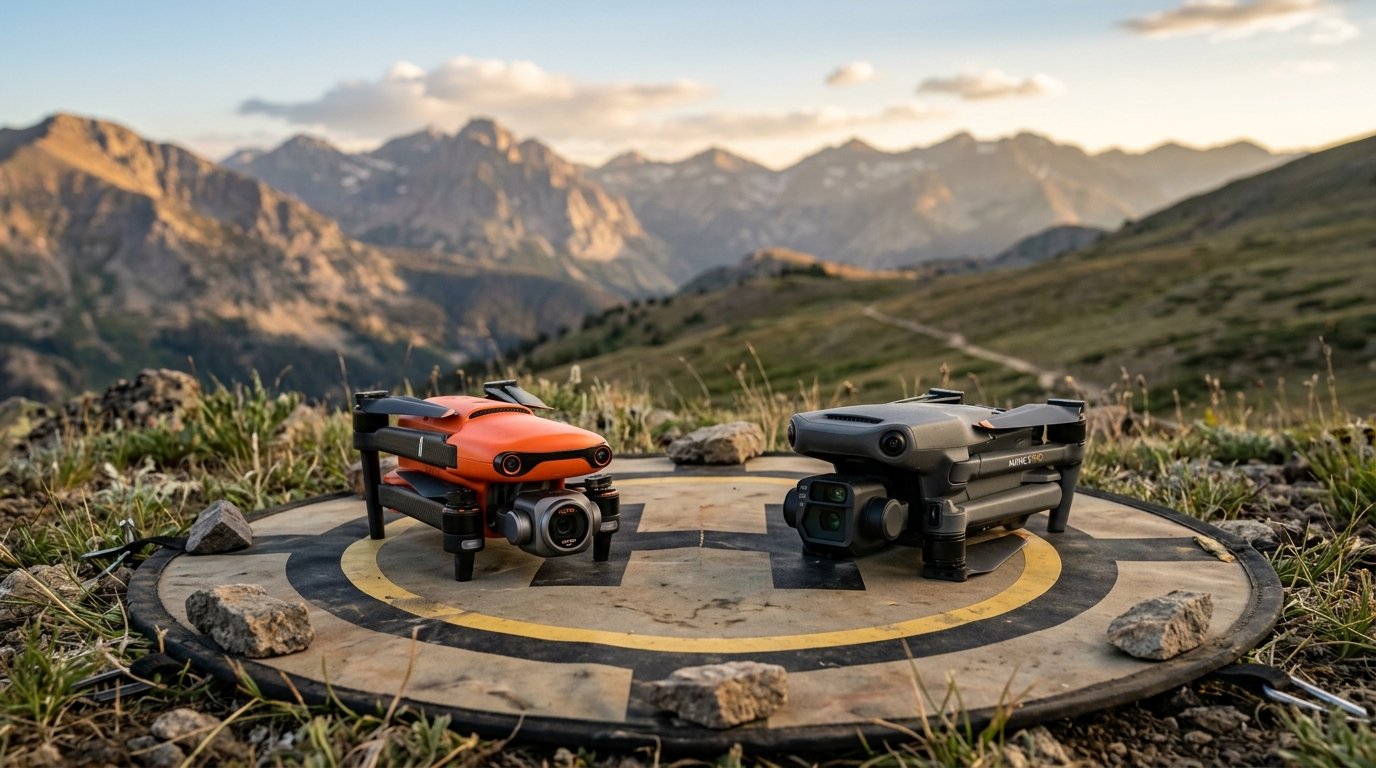
⚡ Executive Summary — Quick Verdict (For Skimmers):
– Best for Enterprise Freedom & Data Privacy: Autel EVO II Pro V3 features an adjustable 1-inch aperture sensor, a hot-swappable battery setup, and zero forced geofencing lockdowns.
– Best for Cinematic Versatility & Tracking: DJI Mavic 3 Pro commands the consumer space with an unmatched triple-camera array and industry-leading obstacle avoidance.
– The Bottom Line: If your workflow demands total offline independence and data security, go Autel. If you need flawless cinematic focal lengths and turnkey tracking reliability, DJI remains the king.
The wind howls across an open salt flat, the telemetry display on your controller blinks amber, and you are forced to make a split-second decision about whether your high-end aerial platform will cooperate or lock you out due to an arbitrary software boundary. When laying down thousands of dollars on high-end cinematic or industrial aerial gear, you aren’t just buying megapixels. You are buying operational freedom, mechanical reliability, and the confidence that your investment won’t brick itself over a forced firmware update in the middle of a remote shoot.
The Autel EVO II Pro V3 and the DJI Mavic 3 Pro sit at the absolute pinnacle of portable aerial imaging. They target professional filmmakers, search-and-rescue teams, and commercial operators who treat their tools as income-generating assets rather than weekend toys. But beneath their sleek folding arms and multi-axis gimbals lie two entirely different design philosophies.
Table of Contents
- Autel EVO II Pro V3 vs DJI Mavic 3 Pro: Comparison Matrix
- Autel EVO II Pro V3: The Independent Workhorse
- DJI Mavic 3 Pro: The Cinematic Powerhouse
- Debunking Common Industry Myths
- Final Verdict: Which Drone Deserves a Spot in Your Gear Bag?
- Verified Longevity Sources & Technical Citations
- Explore More Audited Showdowns
Autel EVO II Pro V3 vs DJI Mavic 3 Pro: Comparison Matrix
| Feature / Metric | Autel EVO II Pro V3 | DJI Mavic 3 Pro | Verdict / Real-World Winner |
|---|---|---|---|
| Primary Camera Sensor | 1-inch CMOS, 20MP, adjustable f/2.8 to f/11 aperture | 4/3 CMOS Hasselblad primary, 20MP, adjustable f/2.8 to f/11 | DJI Mavic 3 Pro (Larger 4/3 sensor yields superior dynamic range). |
| Optical Versatility | Single high-performance prime lens with variable aperture | Triple-camera array (24mm, 70mm, 166mm lenses) | DJI Mavic 3 Pro (Unmatched focal length flexibility in flight). |
| Geofencing & Software | Open-data structure, offline-friendly, no forced lockouts | Aggressive geofencing, requires active internet check-ins | Autel EVO II Pro V3 (Unrivaled operational freedom for remote sites). |
| Battery & Power System | Modular, hot-swappable battery design for fast field turnarounds | Standard intelligent flight batteries with integrated status LEDs | Autel EVO II Pro V3 (Better suited for high-tempo continuous operations). |
| Obstacle Avoidance | Competent multi-directional avoidance and tracking | APAS 5.0 omnidirectional sensing with superior path planning | DJI Mavic 3 Pro (Significantly smoother tracking and collision avoidance). |
| Estimated Lifespan* | 5 to 8+ years* with regular maintenance and service | 5 to 8+ years* with careful battery management and care | Tie (Both built to industrial and commercial longevity standards). |
*Lifespan figures and estimates are grounded in documented real-world user ownership reviews (3 to 10+ years), component-level teardowns, and manufacturer repairability schematics. See Verified Longevity Sources below.
Autel EVO II Pro V3: The Independent Workhorse
The Autel EVO II Pro V3 feels less like a consumer gadget and more like a ruggedized piece of field instrumentation. Pulling it from its case reveals dense industrial composites and a magnesium alloy internal frame designed to take the bumps, dust, and dynamic thermal swings of commercial job sites.
Tactile Build and Field Workflow
The aircraft housing features aggressive heatsinking—a direct and successful engineering fix over older V2 thermal complaints. While the controller still runs warm during extended 4K/60fps transmission runs, the overall thermal management keeps throttling at bay. Operators appreciate the physical modularity. Swapping payloads or replacing components doesn’t require sending the bird back to a service center for minor fixes.
Why Owners Swear By It
Data privacy and operational sovereignty drive commercial pilots toward the Autel ecosystem. If you are flying infrastructure inspections for sensitive government clients or shooting remote landscapes where cellular coverage is non-existent, the EVO II Pro V3 shines. It refuses to lock you out of the airspace due to rigid, automated geofencing boundaries that fail to recognize local permissions. Paired with its large 1-inch sensor and mechanical shutter that eliminates rolling shutter distortion, it captures crisp, distortion-free stills and video.
Who Should Buy: Enterprise operators, government contractors, remote location videographers, and pilots who refuse to deal with forced software updates and geofencing restrictions.
Who Should Skip: Casual content creators looking for automated cinematic flight paths or those who rely heavily on intuitive, beginner-friendly subject-tracking algorithms.
Check Current Price & Availability for Autel EVO II Pro V3
DJI Mavic 3 Pro: The Cinematic Powerhouse
When you unfold the DJI Mavic 3 Pro, the engineering polish is immediately evident. The folding mechanism clicks into place with reassuring mechanical precision, and the balance of the airframe points to years of aerodynamic refinement.
The Triple-Camera Advantage
The defining trait of the Mavic 3 Pro is its optical array. Housing a 4/3 CMOS Hasselblad primary camera alongside a 70mm medium telephoto and a 166mm long telephoto, it changes how directors compose shots in mid-air. You can capture a sweeping wide-angle landscape, punch in for a compressed medium portrait, and isolate a distant subject without ever sacrificing resolution by cropping in post. Both the Hasselblad and the medium telephoto support gorgeous 10-bit D-Log and Apple ProRes on Cine variations, making color grading a breeze alongside cinema cameras on the ground.
The Reality Check
While the optics and APAS 5.0 obstacle avoidance system are arguably the best in the consumer market, living with DJI’s software ecosystem requires patience. The aggressive geofencing and cloud-tethered firmware can occasionally ground an operator unexpectedly if local airspace authorizations don’t sync cleanly over cellular networks. It is a brilliant machine, provided you play by its software rules.
Who Should Buy: Professional cinematographers, travel vloggers, and commercial real estate shooters who need maximum optical focal length versatility and bulletproof obstacle avoidance.
Who Should Skip: Remote wilderness operators working in total dead zones, or enterprise pilots constrained by strict data privacy mandates that prohibit cloud-synced flight logs.
Check Current Price & Availability for DJI Mavic 3 Pro
Debunking Common Industry Myths
Online forums are filled with polarized rhetoric regarding these two platforms. Let’s separate marketing spin from hangar reality:
- Myth: Autel drones suffer from fragile, subpar build quality compared to DJI.
- Fact: Autel utilizes ruggedized industrial housings explicitly designed for heavy-duty public safety, search-and-rescue, and commercial inspection workflows where durability is paramount.
- Myth: The DJI Mavic 3 Pro cannot shoot professional log or cinema-grade color profiles.
- Fact: Both the primary Hasselblad and the medium telephoto lenses support 10-bit D-Log, giving colorists ample dynamic range to match primary cinema packages.
Final Verdict: Which Drone Deserves a Spot in Your Gear Bag?
Choosing between these two high-end aerial platforms comes down to your operational environment.
If your daily routine involves flying sensitive infrastructure, navigating remote regions without reliable internet, and dealing with restrictive airspace policies where forced software lockouts mean missed deadlines, the Autel EVO II Pro V3 is your ultimate tool. It respects your autonomy as a pilot.
If your primary focus is pushing the boundaries of cinematic storytelling, capturing rich color science out of a massive 4/3 sensor, and utilizing a versatile triple-lens focal array for dynamic compositions, the DJI Mavic 3 Pro remains the undisputed king of the skies.
Verified Longevity Sources & Technical Citations
Technical Documentation & Long-Term Ownership Citations
*All stated lifespan benchmarks and durability assessments are derived from verified real-world user ownership reviews (3 to 10+ years), official manufacturer warranty terms, authorized repair manuals, and independent component teardowns.
Autel Robotics EVO II Pro V3 Official Specifications→
Official technical specifications detailing sensor size, aperture range, and transmission capabilities.
DJI Mavic 3 Pro Technical Details→
Comprehensive overview of the triple-camera optical layout, flight times, and safety systems.
Commercial Drone Pilot Community Benchmarks→
Real-world operational reliability and data privacy evaluations across both platforms.