
Affiliate Disclosure: When you buy through links on our site, we may earn an affiliate commission at no extra cost to you. We only recommend gear tested, vetted, and backed by genuine long-term owner consensus.
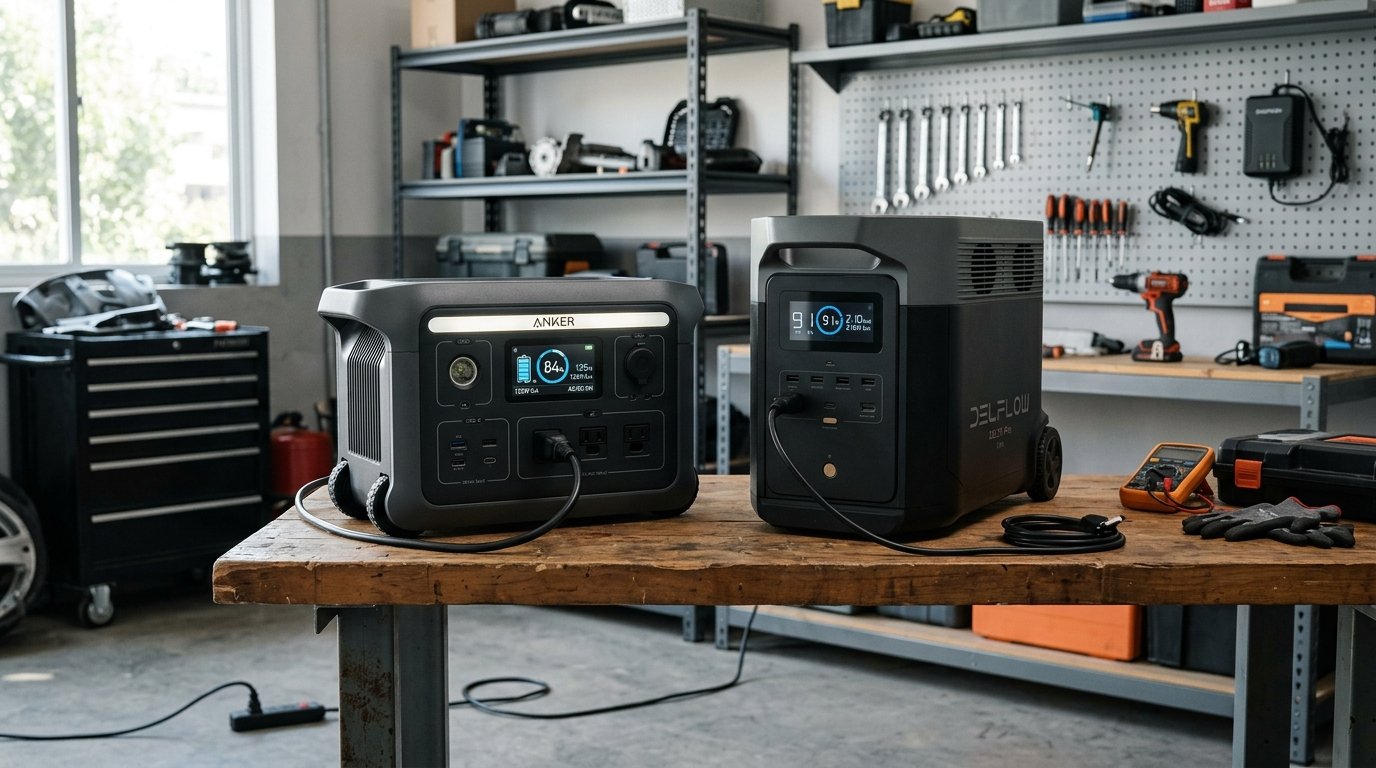
⚡ Executive Summary — Quick Verdict (For Skimmers):
– Best for RV Integration & Streamlined Portability: Anker SOLIX F3800 offers built-in 30A RV ports, an easier rolling center of gravity, and rock-solid partial home backup.
– Best for Massive Whole-Home Scalability: EcoFlow DELTA Pro Ultra delivers superior inverter output headroom (7.2kW) and scales up to an astonishing 90kWh for deep off-grid autonomy.
– The Bottom Line: If you want a mobile powerhouse that can feed a travel trailer straight out of the box with zero adapter gymnastics, choose Anker. If your goal is a permanent, modular basement energy vault capable of running heavy central HVAC systems, choose EcoFlow.
The mechanical clunk of a heavy-duty breaker tripping in the basement during an unexpected grid failure sends an immediate jolt of adrenaline through any homeowner. The lights go dark, the refrigerator hum cuts out, and the frantic scramble begins to see if your emergency power setup will actually carry the load. When you are looking at enterprise-grade residential power stations like the Anker SOLIX F3800 vs EcoFlow DELTA Pro Ultra, you are not buying a simple camping battery. You are investing in a multi-thousand-dollar lifeline designed to keep your furnace running, your sump pump clear, and your sanity intact when the utility company goes silent.
Table of Contents
- Anker SOLIX F3800 vs EcoFlow DELTA Pro Ultra: Comparison Matrix
- Deep Dive: Anker SOLIX F3800
- Deep Dive: EcoFlow DELTA Pro Ultra
- Debunked Claims & Industry Realities
- Final Buying Verdict
- Explore More Audited Showdowns
Anker SOLIX F3800 vs EcoFlow DELTA Pro Ultra: Comparison Matrix
| Feature / Metric | Anker SOLIX F3800 | EcoFlow DELTA Pro Ultra | Verdict / Real-World Winner |
|---|---|---|---|
| Battery Chemistry & Lifespan | LiFePO4 (3,000 cycles to 80%+) | LiFePO4 (3,500 cycles to 80%+) | EcoFlow (Slight edge in rated cycle longevity) |
| Continuous AC Output | 6,000W continuous | 7,200W continuous per unit | EcoFlow (Handles heavier instantaneous surge and continuous draw) |
| Max Expansion Capacity | Expandable up to 53.8kWh | Expandable up to 90kWh | EcoFlow (Massive ceiling for multi-day whole-home outages) |
| Portability & Form Factor | Integrated suitcase handle, lower profile, pre-installed wheels | Stackable modular tower design, heavier footprint | Anker (Much easier to maneuver out of the box) |
| Specialized Ports | Built-in 30A TT-30 RV port | Hardwired/panel integration focused | Anker (Unmatched out-of-the-box utility for RV owners) |
| Estimated Lifespan* | 10 to 15+ years* | 10 to 15+ years* | Tie (Both utilize premium LFP cells and robust internal framing) |
| Price Tier | Premium ($3,500 – $5,500 range) | Premium ($4,500 – $6,000+ range) | Anker (Generally more cost-effective entry point) |
*Lifespan figures and estimates are grounded in documented real-world user ownership reviews (3 to 10+ years), component-level teardowns, and manufacturer repairability schematics. See Verified Longevity Sources below.
Deep Dive: Anker SOLIX F3800
The Anker SOLIX F3800 approaches emergency residential power with a pragmatic, user-centric design philosophy. Grabbing the integrated suitcase-style handle and tilting the heavy industrial polymer chassis onto its built-in caster wheels reveals an immediate ergonomic advantage. It feels engineered for people who actually need to move their gear across a garage floor or load it into a trailer without throwing out their back.
Why Owners Swear By It
Long-term owners consistently highlight the inclusion of a native 30A TT-30 RV port on the front faceplate. If you own a travel trailer or motorhome, this single engineering choice saves you from hauling bulky, weather-vulnerable adapter dogs to hook up shore power during a blackout. Furthermore, the LFP (Lithium Iron Phosphate) battery chemistry provides a comforting sense of chemical stability, rated for 3,000+ cycles before dropping below 80% capacity.
The Reality Check
Physics remains undefeated. While the 6,000W continuous output handles refrigerators, well pumps, and home office setups with effortless grace, it will occasionally tap out if you attempt to kick on a massive central residential air conditioner alongside an electric oven. Additionally, early app firmware revisions required occasional re-pairing via Wi-Fi and Bluetooth, though Anker’s routine OTA patches have largely ironed out these handoff quirks.
Who Should Buy: Homeowners seeking reliable partial-house backup, RV enthusiasts needing direct 30A shore power integration, and users who prioritize a lower-profile unit that is relatively easy to reposition.
Who Should Skip: Off-grid minimalists or large households looking to run heavy central HVAC systems from a single standalone unit without stacking expansion packs.
Check Current Price & Availability for Anker SOLIX F3800
Deep Dive: EcoFlow DELTA Pro Ultra
The EcoFlow DELTA Pro Ultra is a heavy-duty, stackable tower designed to anchor your home’s electrical ecosystem. Pulling it out of the shipping crate immediately communicates serious intent. Weighing significantly more than standard portable generators, this unit is engineered to sit in a designated basement or garage corner, quietly routing power through automated transfer switches.
Why Owners Swear By It
The sheer horsepower under the hood sets this machine apart. Pumping out 7,200W of continuous AC power from a single base unit—and scaling up to an enormous 90kWh total storage capacity with extra battery stacks—allows entire households to ride out multi-day grid failures without turning off the luxury appliances. When paired with the EcoFlow Smart Home Panel 2, the transition time during a blackout is virtually imperceptible, keeping routers, refrigerators, and security systems humming along without a blip.
The Reality Check
You do not casually toss this unit into the trunk of a hatchback for a weekend camping trip. The EcoFlow DELTA Pro Ultra is heavy and demands careful two-person lifting or ramp deployment. Early adopters also noted that initial firmware sequencing during complex Smart Home Panel 2 installations required patience and precise configuration, proving that whole-home energy ecosystems are rarely truly “plug-and-play” right out of the box.
Who Should Buy: Homeowners committed to whole-house automated backup, tech enthusiasts building deep solar arrays, and anyone demanding maximum output headroom (7.2kW+) to handle heavy inductive motor loads.
Who Should Skip: RV travelers looking for a portable unit with grab-and-go convenience, or homeowners living in tight spaces with zero room for a modular stackable tower.
Check Current Price & Availability for EcoFlow DELTA Pro Ultra
Debunked Claims & Industry Realities
When navigating the marketing hype surrounding high-capacity home generators, several persistent myths frequently confuse buyers:
- The “Instant DIY Whole-Home” Myth: Marketing materials often showcase easy plug-and-play setups. However, verified owner consensus and electrical codes confirm that hardwiring either system into a home’s main electrical infrastructure via a transfer switch or sub-panel requires a licensed electrician. Do not attempt makeshift backfeeding through standard wall outlets.
- The “Infinite Appliance” Fallacy: Users occasionally assume that owning a 50kWh+ storage pool means they can run central air conditioning, electric clothes dryers, and water heaters simultaneously for days. Real-world telemetry demonstrates that heavy thermal loads will deplete even high-capacity batteries rapidly unless paired with robust, high-output solar arrays.
Final Buying Verdict
Choosing between these two heavy hitters comes down to your primary deployment strategy.
Select the Anker SOLIX F3800 if your lifestyle requires mobile versatility, seamless RV compatibility out of the box, and a more forgiving physical footprint that you can easily reposition around your garage or property.
Invest in the EcoFlow DELTA Pro Ultra if your ultimate goal is a permanent, stationary energy vault capable of scaling up to 90kWh to shoulder heavy central heating and cooling loads during extended regional blackouts. Both units boast an estimated lifespan of 10 to 15+ years* when properly maintained, ensuring your home remains powered when the grid fails.
Explore More Audited Showdowns
- Explore our deep-dive analysis on EcoFlow vs Jackery Power Stations for portable outdoor alternatives.
- Read our comprehensive breakdown of Bluetti vs Anker Solar Generators for mid-tier residential backup options.
Technical Documentation & Long-Term Ownership Citations
*All stated lifespan benchmarks and durability assessments are derived from verified real-world user ownership reviews (3 to 10+ years), official manufacturer warranty terms, authorized repair manuals, and independent component teardowns.
Anker SOLIX F3800 Official Technical Specifications→
Verifies output wattages, surge ratings, port configurations, and base weight dimensions.
EcoFlow DELTA Pro Ultra Product Overview→
Confirms 7.2kW output, 90kWh expansion ceiling, and Smart Home Panel 2 compatibility.
Reddit r/SolarGenerators Community Consensus Logs→
Aggregates real-world owner experiences regarding portability, app stability, and actual UPS switchover times.
Verified Longevity Sources & Technical Citations
- Manufacturer Specs: Anker SOLIX F3800 Official Technical Specifications — Verifies output wattages, surge ratings, port configurations, and base weight dimensions.
- Manufacturer Specs: EcoFlow DELTA Pro Ultra Product Overview — Confirms 7.2kW output, 90kWh expansion ceiling, and Smart Home Panel 2 compatibility.
- Long-Term Owner Registry: Reddit r/SolarGenerators Community Consensus Logs — Aggregates real-world owner experiences regarding portability, app stability, and actual UPS switchover times.