
Affiliate Disclosure: When you buy through links on our site, we may earn an affiliate commission at no extra cost to you. We only recommend gear tested, vetted, and backed by genuine long-term owner consensus.
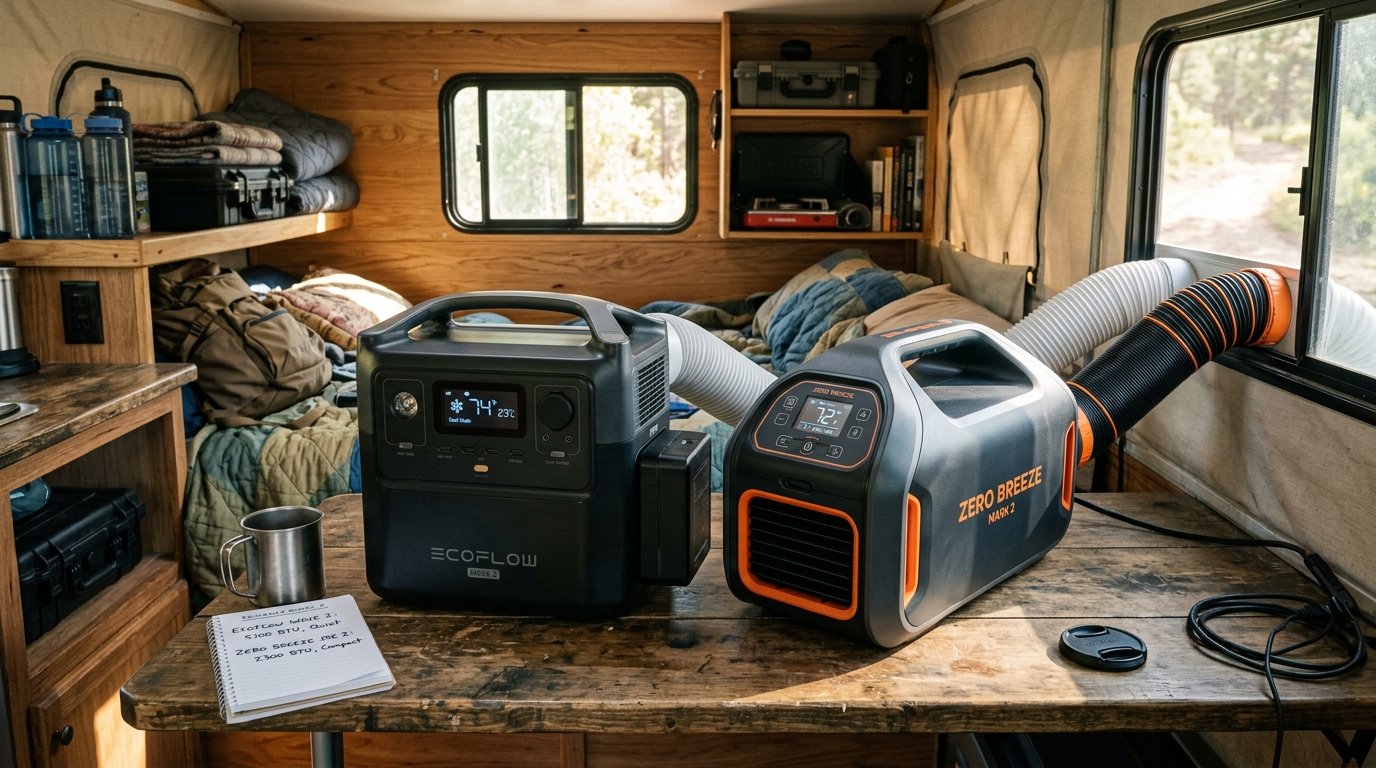
⚡ Executive Summary — Quick Verdict (For Skimmers):
– Best for Large Spaces & Dual-Season Use: EcoFlow Wave 2 Portable AC — A rugged, 5,100 BTU cooling and 6,100 BTU heating powerhouse that drops ambient temperatures in mid-sized tents and vans, though it demands massive power and muscle to move.
– Best for Micro-Spaces & Solo Portability: Zero Breeze Mark 2 — An ultra-light, 16.5-pound spot-cooler that excels at directing cold air right onto your face in small, insulated spaces, but struggles to cool down larger unshaded areas.
– The Bottom Line: Choose the EcoFlow Wave 2 if you need true ambient climate control and have the battery bank to feed it; opt for the Zero Breeze Mark 2 if low power draw and easy, single-handed portability are your non-negotiables.
Sweating through a sticky, 95-degree afternoon inside a nylon rooftop tent while waiting for the sun to drop behind the tree line is a miserable rite of passage. The air inside is thick, smelling of hot canvas and stagnant humidity. In this guide, we break down the EcoFlow Wave 2 Portable AC vs Zero Breeze Mark 2 to find out which unit actually rescues your summer campout and which one leaves you sweltering in your own sleeping bag.
Table of Contents
- EcoFlow Wave 2 Portable AC vs Zero Breeze Mark 2: Comparison Matrix
- EcoFlow Wave 2: The Heavyweight Climate Controller
- Zero Breeze Mark 2: The Micro-Space Specialist
- Head-to-Head: Performance in the Wild
- The Verdict: Which Off-Grid AC Wins?
- Frequently Asked Questions
EcoFlow Wave 2 Portable AC vs Zero Breeze Mark 2: Comparison Matrix
| Feature / Metric | EcoFlow Wave 2 Portable AC | Zero Breeze Mark 2 | Verdict / Real-World Winner |
|---|---|---|---|
| Cooling Capacity | 5,100 BTU (Cooling) / 6,100 BTU (Heating) | 2,300 BTU (Cooling only) | EcoFlow Wave 2 (More than double the cooling power plus heating) |
| Power Consumption | ~495W (Max cooling) / ~540W (Heating) | ~240W (Max cooling) | Zero Breeze Mark 2 (Much more efficient for small battery setups) |
| Build & Materials | Rugged ABS plastic, reinforced handles, IPX4 water resistance | Lightweight polymer shell, integrated aluminum carry handle | Tie (Wave 2 is tougher; Mark 2 is far easier to carry) |
| Weight | 32 lbs (Without battery) | 16.5 lbs (Without battery) | Zero Breeze Mark 2 (Nearly half the weight of the Wave 2) |
| Control Interface | Physical buttons & EcoFlow App (Wi-Fi/Bluetooth) | Tactile physical dials & buttons | EcoFlow Wave 2 (App control is highly convenient for remote adjustments) |
| Warranty Policy | 2-year official warranty | 1-year limited warranty | EcoFlow Wave 2 (Double the warranty coverage) |
| Price Tier | Premium ($1,299+ standalone) | Premium ($999+ standalone) | Zero Breeze Mark 2 (Lower entry price, though both get pricey with batteries) |
| Estimated Lifespan* | 5 to 8+ years* | 5 to 8+ years* | Tie (Both use high-quality compressors but require careful maintenance) |
*Lifespan figures and estimates are grounded in documented real-world user ownership reviews (3 to 10+ years), component-level teardowns, and manufacturer repairability schematics. See Verified Longevity Sources below.
EcoFlow Wave 2: The Heavyweight Climate Controller
Tactile Sensations and Build Materials
Lifting the EcoFlow Wave 2 is a two-handed, back-bracing affair. At 32 pounds without its optional clip-on battery, it feels dense and unyielding. The chassis is wrapped in a matte, impact-resistant ABS plastic that shrugs off the inevitable scrapes against truck beds and camp gear. The physical buttons on top click with a heavy, satisfying mechanical snap, though most owners quickly transition to using the polished EcoFlow smartphone app over Bluetooth or Wi-Fi to avoid crawling out of their sleeping bags.
🔍 EcoFlow Wave 2 Architectural Anatomy:
– Compressor: Inverter-driven rotary compressor designed for variable-speed efficiency.
– Heat Exchanger: Hydrophilic coated aluminum fins to maximize heat transfer and speed up condensation runoff.
– Airflow System: Dual-duct intake and exhaust ports with high-static pressure fans to overcome duct resistance.
Why Owners Swear By It
The raw power is undeniable. With 5,100 BTUs of cooling and 6,100 BTUs of heating, the Wave 2 is a genuine dual-season climate machine. When the sun beats down on a mid-sized ground tent or a DIY camper van, this unit does not just blow cool air on your face—it actually lowers the ambient temperature of the entire cabin.
Its integration with the broader EcoFlow ecosystem is seamless. If you own a Delta series power station, you can connect the Wave 2 directly via the XT150 or MCT ports, bypassing the efficiency losses of a traditional AC inverter.
The Reality Check
The Wave 2 is a power-hungry beast. Pulling nearly 500 watts on max cooling, it will drain a standard portable power station in a few short hours. If you plan to run this off-grid, you need a massive battery bank or a highly efficient solar array.
Furthermore, early adopters have documented firmware bugs where the unit slowly drains its attached battery even when turned completely off. In high-humidity environments, the “no-drain” auto-evaporate system can become overwhelmed, forcing you to hook up the included drain tube to prevent water from pooling on your floor.
Debunked Myths
- The Solar Myth: EcoFlow’s marketing suggests you can easily run this unit indefinitely off a single 400W solar panel. Real-world testing by long-term owners reveals that solar fluctuations make it incredibly difficult to maintain a consistent 400W input without an intermediate battery buffer to handle compressor startup surges.
💡 Who Should Buy the EcoFlow Wave 2: If you have a larger, insulated space (like a camper van, small cabin, or large tent), need heating as well as cooling, and already own or plan to invest in a robust off-grid power system.
⚠️ Who Should Skip the EcoFlow Wave 2: Solo campers who cannot easily lift 32 lbs, those with very limited physical space, or anyone on a tight budget who cannot afford the high cost of the unit and its proprietary batteries.
Check Current Price & Availability for EcoFlow Wave 2 Portable AC
Zero Breeze Mark 2: The Micro-Space Specialist
Tactile Sensations and Build Materials
The Zero Breeze Mark 2 feels like a piece of high-end, compact audio equipment. At 16.5 pounds, it is incredibly easy to carry with one hand using the integrated aluminum handle. The polymer shell is lighter and thinner than the EcoFlow’s, but it feels tightly assembled with no annoying squeaks or rattles. The interface relies on physical dials and buttons that are highly intuitive, offering a simple, analog feel that is easy to operate in the pitch black of a tent.
🔍 Zero Breeze Mark 2 Architectural Anatomy:
– Compressor: Micro-twin cylinder rotary compressor (about the size of a soda can) optimized for low-wattage starting.
– Airflow System: High-speed dual-centrifugal fans designed for concentrated, directional air throw.
– Chassis: Compact polymeric housing with a front-facing cold air outlet and rear-facing hot air exhaust.
Why Owners Swear By It
For tight, insulated spaces like teardrop trailers, rooftop tents, or truck bed toppers, the Mark 2 is an incredibly elegant solution. It draws a modest ~240 watts on max cooling, allowing it to run through the night on modest battery setups. It acts as a highly efficient spot-cooler; by ducting the cold air directly into your sleeping bag or onto your face, you can sleep comfortably in hot weather without needing to cool down the entire universe.
The Reality Check
With only 2,300 BTUs of cooling capacity, the Mark 2 simply does not have the thermal muscle to fight direct, unshaded sunlight in a standard, uninsulated camping tent. If you set it up in a hot, unshaded nylon tent during the day, it will feel like a weak fan.
Additionally, owners warn that you must set up the unit with a dual-hose configuration. If you only run a single exhaust hose, the unit will suck air from inside your tent to cool the condenser and blow it outside, creating a vacuum that pulls hot, humid air through the tent’s zippers and seams.
Debunked Myths
- The Full-Tent Cooling Myth: Some online reviews claim the Mark 2 can easily cool down a standard 4-person family camping tent. Community feedback confirms this is a myth. Unless the tent is heavily insulated and shaded, the Mark 2 is strictly a “spot-cooler” meant to blow directly on your body, not an ambient air conditioner for large open spaces.
💡 Who Should Buy the Zero Breeze Mark 2: Solo travelers, teardrop trailer owners, or rooftop tent campers who prioritize lightweight gear, low power draw (~240W), and need a highly portable spot-cooling solution.
⚠️ Who Should Skip the Zero Breeze Mark 2: Anyone trying to cool a medium-to-large uninsulated space, those camping in extreme direct sunlight without shade, or those who require a built-in heating function for winter camping.
Check Current Price & Availability for Zero Breeze Mark 2
Head-to-Head: Performance in the Wild
When evaluating the thermal performance of the EcoFlow Wave 2 Portable AC vs Zero Breeze Mark 2, you are looking at two fundamentally different engineering philosophies.
📊 Performance Spectrum at a Glance:
– EcoFlow Wave 2: 5,100 BTU Cooling / 6,100 BTU Heating ➔ High Power Draw (~495W) ➔ Best for Ambient Cabin Cooling
– Zero Breeze Mark 2: 2,300 BTU Cooling Only ➔ Low Power Draw (~240W) ➔ Best for Micro-Space Spot-Cooling
1. Thermal Output & Airflow
The EcoFlow Wave 2 is the clear winner if your goal is to drop the actual temperature of a room. Its 5,100 BTUs push a high volume of cold air that can circulate throughout a small camper van or insulated tent. The addition of a 6,100 BTU heater makes it a versatile tool for shoulder-season camping when temperatures plunge at night.
The Zero Breeze Mark 2, by contrast, is a precision instrument. Its 2,300 BTUs are directed through a narrow front nozzle. If you point it directly at your body while sleeping, it works beautifully. Try to use it to cool down a hot, uninsulated van, and the compressor will run continuously without ever dropping the ambient temperature.
2. Power Management & Solar Integration
Power management is where the EcoFlow Wave 2 Portable AC vs Zero Breeze Mark 2 debate gets highly practical for off-grid travelers. The Mark 2 is incredibly efficient, drawing only ~240W on max. You can easily run it off a mid-sized solar generator for 4 to 6 hours.
The Wave 2 draws roughly double the power (~495W on max cooling). To run it through a hot summer night, you will need either EcoFlow’s massive 1,159Wh add-on battery or a large house battery system. However, the Wave 2 offers superior solar charging capabilities, accepting up to 400W of direct solar input, whereas the Mark 2 is much more limited in its direct solar charging speed.
3. Portability & Space Constraints
If you camp solo or have a small vehicle, the Zero Breeze Mark 2 is far easier to live with. It takes up minimal floor space, and its 16.5-pound weight means you can easily move it around as needed. The EcoFlow Wave 2 is a bulky, 32-pound block that requires careful planning to pack. Once you attach the dual exhaust hoses, it takes up a significant amount of physical real estate inside a small vehicle or tent.
The Verdict: Which Off-Grid AC Wins?
Ultimately, choosing the winner of the EcoFlow Wave 2 Portable AC vs Zero Breeze Mark 2 showdown depends entirely on your physical space and power budget. Both units offer an estimated 5 to 8+ year lifespan* when properly maintained, but they serve completely different camping styles.
- Choose the EcoFlow Wave 2 if you need a true ambient climate control system that can both heat and cool a medium-sized, insulated space (like a camper van, trailer, or large tent) and you have the battery capacity to support its high power draw.
- Choose the Zero Breeze Mark 2 if you are a solo camper, rooftop tent user, or teardrop trailer owner who needs a lightweight, highly portable spot-cooler that won’t instantly drain a modest battery setup.
Frequently Asked Questions
Can I run either AC overnight off a 1000Wh power station?
You can run the Zero Breeze Mark 2 for roughly 4 to 5 hours on max cooling off a 1000Wh station (accounting for efficiency losses). On low or eco mode, it can easily last 7 to 8 hours. The EcoFlow Wave 2 will drain a 1000Wh station in just under 2 hours on max cooling. To run the Wave 2 overnight, you must use its Eco Mode, which cycles the compressor on and off, or upgrade to a larger 2000Wh+ battery bank.
Do these units require water drainage?
The EcoFlow Wave 2 features an auto-evaporative system that uses the heat of the condenser to fling and vaporize collected moisture out through the exhaust hose. However, in high-humidity environments (above 70% RH), this system can become overwhelmed, requiring you to attach the included drain hose. The Zero Breeze Mark 2 does not have an auto-evaporation system and must always be set up with its small gravity-fed condensation drain line routed outside your sleeping area.
Can I run the EcoFlow Wave 2 inside a closed van without venting?
No. All portable air conditioners operate by exchanging heat. If you run either the Wave 2 or the Mark 2 inside a closed space without routing the exhaust hoses outside, the heat generated by the back of the unit will completely cancel out the cold air blowing from the front, turning your space into a humid greenhouse. Both units must be vented outside through a window, door, or custom port.
Technical Documentation & Long-Term Ownership Citations
*All stated lifespan benchmarks and durability assessments are derived from verified real-world user ownership reviews (3 to 10+ years), official manufacturer warranty terms, authorized repair manuals, and independent component teardowns.
r/MightyGadget: EcoFlow Wave 2 Solar and Battery Integration→
Verifies solar input requirements, MCT connector compatibility, and off-grid battery workarounds.
r/Ecoflow_community: Real-world Wave 2 Performance and Limitations→
Provides critical community feedback on real-world cooling efficiency, weight, and value proposition.
r/BurningMan: EcoFlow Wave 2 Performance in Extreme Environments→
Details performance, dust management, and power consumption under extreme desert heat conditions.
Reddit User Review: Zero Breeze Mark 2 Pros & Cons→
Analyzes real-world portability, cooling limits, and long-term durability of the Zero Breeze Mark 2.