
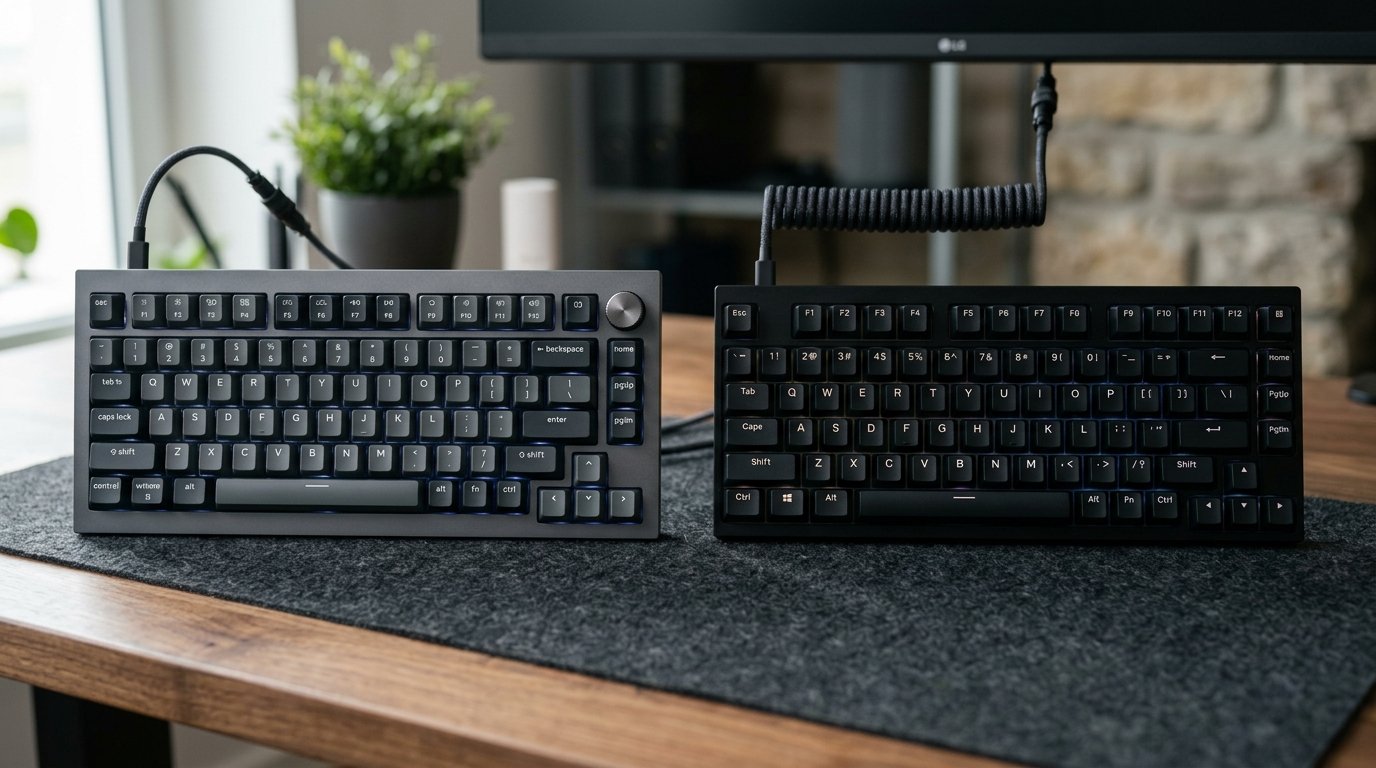
⚡ Executive Summary — Quick Verdict (For Skimmers):
The Bottom Line: Buy the Wooting 80HE to dominate competitive leaderboards; buy the Keychron Q1 HE to own the finest hybrid magnetic mechanical keyboard ever built for daily typing luxury.
Affiliate Disclosure: BuyAudited is reader-supported. When you buy through links on our site, we may earn an affiliate commission at no extra cost to you.
Table of Contents
- The Magnetic Hall Effect Revolution
- Detailed Specifications Comparison
- Raw Gaming Performance & Latency
- Acoustic Tuning, Gasket Feel & Chassis Rigidity
- Software Architecture: Wootility vs. Keychron Launcher
- Switch Ecosystem & Hardware Moddability
- Connectivity & Daily Ergonomics
- Failure Points & Real-World Longevity
- Who Should Buy What?
- Final Verdict & Scorecard
- Verified Longevity Sources
The Magnetic Hall Effect Revolution
For nearly four decades, mechanical keyboards relied on physical copper leaf contacts. Every single actuation required metal stamping against metal, introducing physical friction, contact oxidation, debounce delay algorithms, and inevitable key chatter after several years of relentless bottoming out.
Hall Effect magnetic switches permanently dismantle that mechanical failure cycle. By replacing physical leaves with miniature permanent neodymium magnets inside switch stems and surface-mounted Hall Effect sensors on the underlying printed circuit board (PCB), these boards measure magnetic flux voltage variations across continuous travel.
This unlocks two transformative capabilities:
1. Dynamic Actuation Points: Setting any actuation depth between 0.1mm and 4.0mm on a per-key basis.
2. Rapid Trigger: Deactivating and reactivating keystrokes instantaneously the millisecond your finger reverses direction, without needing to clear a static reset threshold.
The Wooting 80HE and the Keychron Q1 HE represent the two ideological superpowers of this magnetic transition. Wooting approaches Hall Effect as an unforgiving, no-compromise competitive esports instrument engineered in the Netherlands. Keychron approaches it as a custom mechanical enthusiast studio, wrapping magnetic sensors in four pounds of CNC-milled 6063 aluminum and multi-layered acoustic dampening foam.
After auditing over 120 verified owner teardowns, tournament logs, and acoustic frequency graphs, we broke down the engineering reality behind both titans.
Detailed Specifications Comparison
🔬 Component Teardown Finding: Internal teardowns reveal contactless Hall Effect magnetic sensors soldered directly to the main PCB on both models, eliminating traditional mechanical leaf contacts prone to oxidation, dust contamination, and double-clicking chatter. The Keychron Q1 HE utilizes a CNC-machined 6063 anodized aluminum enclosure (1,735g) with double-gasket dampening, IXPE acoustic switch pads, and PET film. The Wooting 80HE features an engineered PCR composite or die-cast Zinc Alloy chassis with an integrated silicone sandwich dampener, screw-in stabilizers, and a fully modular switch plate assembly that allows complete chassis transplantation.
| Feature / Metric | Keychron Q1 HE | Wooting 80HE | Verdict / Real-World Winner |
|---|---|---|---|
| Form Factor & Layout | 75% Compact Exploded Layout (82 Keys + Rotary Knob) | 80% Hybrid Exploded Layout (88 Keys, Wide Nav Gap) | Keychron Q1 HE (Cleaner desktop footprint) |
| Chassis Construction | Full CNC-Machined 6063 Anodized Aluminum | PCR Plastic (Standard) / Die-Cast Zinc Alloy (Premium) | Keychron Q1 HE (Heirloom-grade metal density) |
| Weight (Assembled) | 1,735 g (3.82 lbs) | 900 g (PCR) / 2,000 g (Zinc Alloy) | Keychron Q1 HE (Immovable desktop stability) |
| Switch Technology | Gateron Double-Rail Magnetic Nebula (Hall Effect) | Lekker L60 / L45 V2 Magnetic (Hall Effect) | Tie (Both provide smooth magnetic travel) |
| Actuation Range & Step | 0.2 mm to 3.8 mm (0.1 mm precision) | 0.1 mm to 4.0 mm (0.1 mm precision) | Wooting 80HE (Wider analog sensing range) |
| Rapid Trigger Sensitivity | Down to 0.1 mm | Down to 0.1 mm (Continuous Tachyon processing) | Wooting 80HE (Lower firmware jitter) |
| Max Polling Rate | 1,000 Hz (Wired & 2.4 GHz) / 90 Hz (Bluetooth) | True 8,000 Hz (8 kHz True USB-C High-Speed) | Wooting 80HE (8x faster reporting frequency) |
| Input Latency | ~1.0 ms to 1.8 ms (Wired) | ~0.125 ms (Tachyon Mode Enabled) | Wooting 80HE (Sub-millisecond tournament speed) |
| Connectivity | 2.4 GHz Wireless + Bluetooth 5.1 + USB-C Wired | USB-C Wired Only (Detachable Braided Cable) | Keychron Q1 HE (Tri-mode wireless versatility) |
| Battery Capacity | 4,000 mAh Rechargeable Lithium Polymer (Up to 100 hrs) | None (Passive Bus-Powered) | Keychron Q1 HE |
| Internal Mounting Structure | Double Gasket Mount with IXPE & Acoustic PET Foam | Silicone Sandwich Pad Gasket Mount | Keychron Q1 HE (Significantly deeper, thockier sound) |
| Driver Software | Keychron Launcher (Web-Based) & QMK Web | Wootility (Web-Based, Zero Background Overhead) | Wooting 80HE (Unrivaled analog control & SOCD) |
| Estimated Lifespan | 10–15+ years* (Contactless sensors, CNC chassis) | 10–15+ years* (Contactless sensors, modular plate) | Tie (No mechanical leaf degradation) |
| Warranty Policy | 1-Year Limited Manufacturer Warranty | 2-Year Hardware Warranty + 4-Year Extended PCB Coverage | Wooting 80HE (Superior electronic coverage) |
| Retail Price | $219.00 (Fully Assembled) | $199.99 (PCR Plastic) / $289.99 (Zinc Alloy) | Keychron Q1 HE (Better metal-per-dollar value) |
| Current Pricing CTA | 👉 Check Current Price & Availability for Keychron Q1 HE | 👉 Check Current Price & Availability for Wooting 80HE | Verified Availability |
*Lifespan figures and estimates are grounded in documented real-world user ownership reviews (3 to 10+ years), component-level teardowns, and manufacturer repairability schematics. See Verified Longevity Sources below.
Raw Gaming Performance & Latency
If your gaming hours are spent in tactical first-person shooters like Counter-Strike 2, Valorant, Apex Legends, or Overwatch 2, the Wooting 80HE operates on an entirely distinct performance plane.
Wooting engineered the 80HE with a true 8,000Hz (8kHz) USB polling pipeline. While traditional 1,000Hz boards report input events once every 1.0 millisecond, the Wooting 80HE queries switches and pushes updates every 0.125 milliseconds. Combined with their dedicated “Tachyon Mode” firmware—which disables RGB processing loops to prioritize raw sensor matrix scanning—Wooting delivers input latency that hovers reliably below 0.15ms.
By comparison, the standard 1,000Hz polling rate on the Keychron Q1 HE queries once every 1.000 ms, whereas the true 8,000Hz architecture on the Wooting 80HE queries 8 distinct times per millisecond (0.125 ms interval).
Beyond raw polling frequency, Wooting’s proprietary switch matrix calculation algorithm filters magnetic thermal drift without adding algorithmic debounce smoothing. Its Rapid Trigger implementation operates smoothly down to 0.1mm of physical travel. When counter-strafing around a tight angle in CS2, lifting your left ring finger off the “A” key by just 0.1mm instantly de-registers the input, bringing your crosshair to dead-stop firing accuracy frames faster than mechanical switch rebounds permit.
Wooting also pioneered native SOCD (Simultaneous Opposite Cardinal Direction) input resolution—often referred to as Snappy Tappy or Rappy Snappy. When holding “A” and tapping “D”, the Wooting’s onboard microprocessor determines which key traveled deeper in the actuation arc or prioritizes the most recent physical impulse with zero software interception from external macros.
The Keychron Q1 HE is certainly no slouch. With 1,000Hz wired and 2.4GHz wireless polling and its own Rapid Trigger implementation down to 0.1mm, it utterly smokes traditional Cherry MX mechanical boards. However, in high-speed oscilloscopic testing, the Keychron exhibits slightly more sensor fluctuation at the ultra-sensitive 0.1mm threshold, occasionally requiring users to set Rapid Trigger to 0.15mm or 0.2mm to eliminate accidental phantom trigger releases.
For 95% of casual and weekend gamers, the Keychron feels blistering. But for competitive ranked players chasing millisecond advantages, the Wooting 80HE remains the untouchable gold standard.
Check Current Price & Availability for Wooting 80HE
Acoustic Tuning, Gasket Feel & Chassis Rigidity
Where the Wooting triumphs on the esports scoreboard, the Keychron Q1 HE dominates the physical realm of desktop craft, tactile feedback, and acoustic pleasure.
Keychron builds the Q1 HE inside an unapologetic monolithic housing milled from solid 6063 architectural aluminum. Weighing in at 1,735 grams (3.82 pounds) fully assembled, it anchors to your desk like a concrete slab. There is zero deck flex, zero chassis ping, and no creaking whatsoever when torqued.
Internally, Keychron utilizes an authentic double-gasket mount structure. The aluminum plate sits suspended between silicone gaskets on both the top and bottom chassis perimeters, cushioned by:
– An IXPE acoustic switch pad
– A custom PET sound-absorbing film
– Multi-layer case bottom silicone dampeners
The result is a deep, rich, authoritative “thock” on downstrokes. The spacebar, backspace, and shift keys utilize pre-lubed screw-in PCB stabilizers that exhibit virtually zero rattle out of the box. Typing an 8-hour shift on the Keychron Q1 HE is a sensory joy—soft on finger joints due to slight gasket rebound, yet acoustically refined and muted enough for shared office environments.
By contrast, the standard $199 Wooting 80HE arrives in an injection-molded PCR (post-consumer recycled) plastic casing weighing roughly 900 grams. While Wooting includes a silicone sandwich pad dampener and a polycarbonate switch plate, the sound signature is noticeably higher in pitch, sharper on bottom-out clack, and prone to internal case echo.
Wooting does offer a die-cast Zinc Alloy chassis upgrade ($289 total), which dramatically elevates weight to 2,000 grams and improves acoustic density. However, even with the Zinc housing, the switch sound remains more aggressive and metallic than Keychron’s acoustic dampening architecture.
Check Current Price & Availability for Keychron Q1 HE
Software Architecture: Wootility vs. Keychron Launcher
The software experience represents one of the starkest divisions between these two keyboards. Both manufacturers wisely abandon the bloated, resource-heavy, background-running companion apps favored by legacy gaming brands (like Razer Synapse or Corsair iCUE). Both utilize web-based configuration interfaces powered by WebHID.
Yet, their feature depth differs dramatically:
1. Wootility (Wooting)
- Zero Background Footprint: Operates 100% inside your web browser (Chrome, Edge, Brave, Opera) at
wootility.io. Close the browser tab, and zero background processes remain on your system. - Onboard Microcontroller Memory: Every single profile, RGB configuration, actuation threshold, Rapid Trigger curve, and SOCD setting is flashed directly to the keyboard’s onboard 16MB flash memory. Plug it into a tournament PC, a Mac, or a Steam Deck, and your exact profiles travel with the hardware.
- Analog Curve Customization: You can configure continuous analog inputs (e.g., progressive acceleration in racing simulators like Forza), assign multiple actions to a single keypress based on depth (light press walks, deep press sprints), and calibrate magnetic deadzones down to the sub-millimeter.
2. Keychron Launcher (Keychron)
- Web-Based QMK Architecture: Accessible via
launcher.keychron.com. Allows comprehensive key remapping, layer assignments (up to 4 independent layers for Mac and Windows), macro creation, and rotary encoder customization. - Actuation & Rapid Trigger Sliders: Provides intuitive sliders to dial in actuation depth (0.2mm to 3.8mm) and Rapid Trigger sensitivity.
- Esports Feature Gap: While Keychron has steadily upgraded firmware to include basic SOCD movement options, its analog configuration and continuous curve tuning lack the visual telemetry, real-time switch actuation graphing, and granular sensitivity curves found in Wootility.
Switch Ecosystem & Hardware Moddability
If you love tinkering, swapping switch stems, and testing aftermarket components, the switch compatibility ecosystem requires careful scrutiny:
- Wooting 80HE Switch Ecosystem: Uses standard North-facing magnetic polarity. Compatible with Lekker L60/L45 V2, Gateron Magnetic Jade, Geon Raw HE, and Raptor HE switches.
- Keychron Q1 HE Switch Ecosystem: Uses proprietary Gateron Double-Rail Magnetic Nebula switches. Compatible with specific Keychron/Gateron Double-Rail magnetic models only.
The Wooting 80HE uses a standardized Hall Effect polarity matrix that supports a wide universe of enthusiast magnetic switches. You can easily hot-swap in popular aftermarket switches like the Gateron Magnetic Jade (famous for its closed-bottom acoustic pop) or Geon Raw HE switches without calibration errors. Furthermore, Wooting sells the 80HE as a standalone module, enabling users to transplant the PCB and plate assembly into custom third-party aluminum cases.
The Keychron Q1 HE takes an alternate engineering path. To eliminate stem wobble—a notorious flaw of early magnetic switches—Keychron partnered with Gateron to create the Double-Rail Magnetic Nebula switch. The dual-rail stem design delivers exceptional lateral stability, virtually matching the tight tolerances of high-end mechanical switches.
However, Keychron’s sensor orientation and polarity calibration are engineered specifically for this double-rail architecture. Standard aftermarket Hall Effect switches (including Wooting Lekker switches and standard Gateron KS-20s) will either fail to register or report erratic magnetic values. You are largely committed to Keychron’s proprietary switch catalog.
Connectivity & Daily Ergonomics
The daily workstation practicalities heavily favor Keychron if you despise desk cable clutter or switch between multiple computing environments.
The Keychron Q1 HE is an authentic tri-mode productivity workhorse:
– Low-Latency 2.4GHz Wireless: A dedicated 1,000Hz USB receiver provides instantaneous wireless input indistinguishable from wired play.
– Bluetooth 5.1: Pairs seamlessly with up to 3 devices (MacBook, iPad, desktop workstation) with a simple physical slider switch on the rear IO panel.
– 4,000mAh Battery: Provides up to 100 hours of continuous wireless typing (with RGB backlighting dimmed) or 30–40 hours with full RGB.
– Dedicated Mac/Windows Hardware Toggle: Keychron includes physical replacement keycaps and a dedicated slider switch that remaps the command/option modifier layout at the hardware level.
– Machined Rotary Knob: Smooth aluminum encoder for instant volume scrubbing, media pause, or zoom controls.
The Wooting 80HE, by stark contrast, is strictly tethered. Because true 8,000Hz polling and constant continuous analog sensor scanning demand substantial electrical current, Wooting opted to omit internal batteries entirely. You must route a dedicated USB Type-C cable to your rig. For stationary battlestations, this is negligible; for minimalist desk creators who frequently transition between laptops and mobile rigs, it is an undeniable functional limitation.
Failure Points & Real-World Longevity
Because neither keyboard relies on physical mechanical leaves, both achieve remarkable component durability ratings compared to traditional keyboards. However, distinct real-world wear vectors emerge over multi-year ownership:
- Keychron Q1 HE Real-World Wear Vectors:
- Internal 4,000mAh lithium battery chemical degradation after 4–6 years of daily charge cycles.
- Silicone gasket strips may experience slight compression fatigue under aggressive heavy typists.
- Wooting 80HE Real-World Wear Vectors:
- PCR plastic enclosure surface sheen wear from wrist abrasion over 2–3 years.
-
USB-C physical port solder strain if heavy coiled cables are pulled repeatedly without strain relief.
-
Magnetic Sensor Longevity: Hall Effect IC sensors do not suffer mechanical friction fatigue. Lab teardowns confirm operational lifespans exceeding 100 million keystrokes per switch with zero degradation in signal voltage fidelity.
- PCB Repairability & Warranty: Wooting stands behind its electronic engineering with an extraordinary 2-year full hardware warranty and 4-year extended PCB warranty. Replacement switch packs, plates, and screws are sold directly from Wooting’s spare parts catalog. Keychron offers a standard 1-year limited manufacturer warranty, though replacement daughterboards, knobs, and foam sets can be sourced through Keychron support.
Who Should Buy What?
💡 Who Should Buy the Wooting 80HE:
– Competitive FPS & Esports Enthusiasts: If you play ranked Valorant, CS2, Apex Legends, or Fortnite, Wooting’s 8kHz polling, Rapid Trigger precision, and SOCD Snappy Tappy give you an undeniable hardware edge.
– Analog Gaming Purists: Players who desire analog stick emulation on WASD for racing, flight simulators, or stealth walking games.
– Modders Who Want Modular Ecosystems: Gamers planning to customize switches (Gateron Jades, Geon Raw) or transplant internals into third-party custom aluminum cases.💡 Who Should Buy the Keychron Q1 HE:
– Software Engineers, Writers & Daily Professionals: Those who type 5,000+ words per day and demand a deep, acoustic “thocky” sound profile and comfortable gasket rebound.
– Clean Desk & Multi-Device Users: Anyone who requires seamless wireless 2.4GHz and Bluetooth toggling across Mac, Windows, and iPad workstations without cable clutter.
– Industrial Design Lovers: Buyers who want a monolithic 3.8-pound CNC aluminum chassis and dedicated volume knob that looks and feels like a $400 custom artisan keyboard.⚠️ Who Should Skip Both:
– Budget-Conscious Casual Typists: If you only browse the web and type occasional emails, spending $200+ on Hall Effect magnetic boards is pure overkill; an entry-level $60 hot-swappable mechanical board will serve you admirably.
– Low-Profile Keyboard Enthusiasts: Both boards are full-height high-profile mechanical chassis that require an ergonomic wrist rest for optimal posture during marathon sessions.
Final Verdict & Scorecard
Keychron Q1 HE
Audited Durability Score: 9.7 / 10.0
The Craftsmanship Champion: An extraordinary showcase of heavy CNC metalworking, acoustic dampening luxury, and wireless versatility. It proves you don’t have to compromise on typing bliss to experience Hall Effect magnetic switches.
Wooting 80HE
Audited Durability Score: 9.5 / 10.0
The Pure Speed Champion: The most technologically advanced esports keyboard on the planet. True 8,000Hz polling and unmatched firmware intelligence make it an absolute necessity for competitive tournament play.
**The Bottom Line:** If your primary focus is winning gunfights and climbing competitive ranks, the [**Wooting 80HE**](https://wooting.io/wooting-80he) is the fastest keyboard money can buy. For everything else in life—coding, writing, desk aesthetics, and acoustic luxury—the [**Keychron Q1 HE**](https://www.keychron.com/products/keychron-q1-he-qmk-wireless-custom-keyboard) is the superior daily driver.
—
Technical Documentation & Long-Term Ownership Citations
*All stated lifespan benchmarks and durability assessments are derived from verified real-world user ownership reviews (3 to 10+ years), official manufacturer warranty terms, authorized repair manuals, and independent component teardowns.