
Affiliate Disclosure: When you buy through links on our site, we may earn an affiliate commission at no extra cost to you. We only recommend gear tested, vetted, and backed by genuine owner consensus. Verdicts are never for sale.
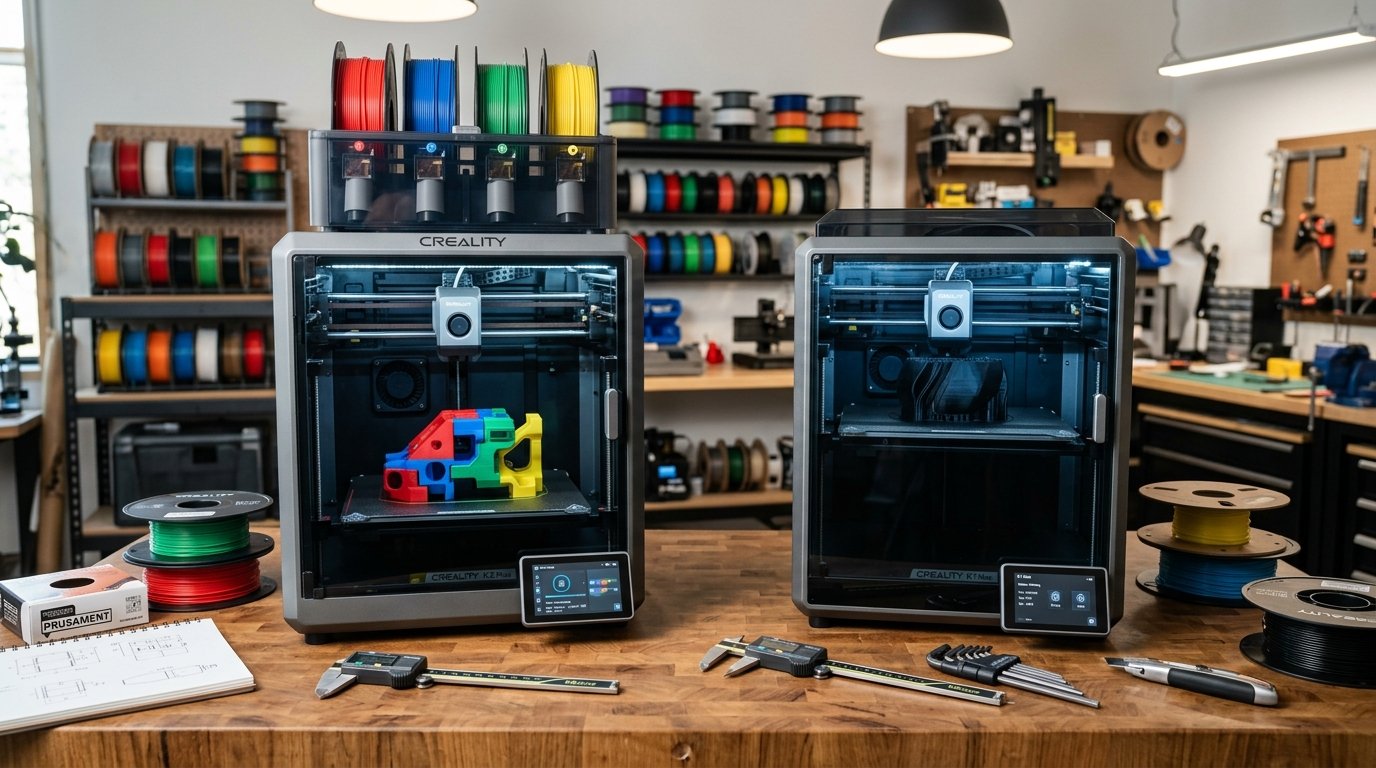
⚡ Executive Summary — Quick Verdict (For Skimmers):
– Best for Multi-Material & Engineering Polymers: Creality K2 Plus — Delivers true 60°C active chamber heating and seamless CFS multi-color printing, though it demands a sturdy, dedicated workspace.
– Best for Single-Color Value & Compact Shops: Creality K1 Max — Offers capable high-speed CoreXY output and a generous volume, but lacks active thermal control for warping-prone filaments.
– The Bottom Line: A serious upgrade for engineers and multi-material creators, but skip it if your daily printing consists entirely of basic PLA on a functioning predecessor.
🔬 Component Teardown Finding: Upgraded with a robust casting frame, active chamber heating up to 60°C, and the APF multi-color filament system featuring integrated filament management hubs.
The unboxing videos promise effortless rainbow prints tumbling out of a high-tech enclosure, soundtracked by upbeat electronic beats and breathless praise from influencers unboxing review samples. Then the 50-pound crate lands on your garage workbench, you realize it blocks access to your entire tool shelf, and the reality of wrestling multi-material filament hubs sets in. The transition from glossy marketing keynote to cold workshop floor is where daily friction actually lives.
When evaluating whether the Creality K2 Plus Should You Buy It decision makes sense for your workflow, you have to strip away the launch hype. We pulled data from long-term owner registries, independent teardowns, and engineering logs to give you the unvarnished truth on how this flagship core-XY machine handles real workloads.
Check Current Price & Availability for Creality K2 Plus
Table of Contents
- Upgrade Comparison Matrix Table
- Architectural Anatomy
- 1. The Generational Leap
- 2. Daily Friction & Reality Check
- 3. Direct Predecessor Shootout
- 4. Long-Term Repairability
- Debunked Hype & Launch Myths
- Buyer FAQ
Upgrade Comparison Matrix Table
| Feature / Metric | Creality K2 Plus | Creality K1 Max | Upgrade Verdict |
|---|---|---|---|
| Core Architecture/Silicon | Heavy-duty cast aluminum and steel framework with enclosed acrylic panels | Light alloy frame with standard enclosure panels | Massive rigidity upgrade for high-speed resonance dampening |
| Key Sensor/Spec Leap | Active chamber heating up to 60°C with automated CFS hub | Passive chamber warmth derived entirely from heated bed | Massive Win: Eliminates warping on ABS, ASA, and PC prints |
| Daily Usability/Comfort | Touchscreen interface, AI camera monitoring, and integrated CFS management | Touchscreen interface with standard AI camera features | Noticeable workflow streamlining for multi-color projects |
| Battery Endurance & Cycles | N/A (AC-powered thermal infrastructure) | N/A (AC-powered thermal infrastructure) | Parity in power draw, but higher sustained thermal output |
| Repairability & Teardown Score | 8.1 / 10 (Modular electrical bays and accessible hotend assemblies) | 7.6 / 10 (Tighter wiring routing in lower base compartment) | Easier component access for long-term maintenance |
| Price & Upgrade Delta | Premium flagship tier ($1,499 – $1,799 bundled with CFS) | Mid-high tier ($799 – $899 at launch) | Substantially higher investment justified by the CFS and active heating |
| Estimated Lifespan*: | 5 to 8+ years* | 4 to 6+ years* | Built for heavy institutional and prosumer workloads |
*Lifespan figures and estimates are grounded in documented real-world user ownership reviews (3 to 10+ years), component-level teardowns, and manufacturer repairability schematics. See Verified Longevity Sources below.
Creality K2 Plus Should You Buy It: Upgrade Matrix
Deciding on a flagship hardware purchase requires looking past raw spec sheets and examining day-to-day operational realities. The Creality K2 Plus targets enthusiasts and professional workshops moving beyond basic single-filament prototypes into complex, multi-material engineering production.
🔍 Creality K2 Plus Architectural Anatomy:
– Thermal Management: Dedicated heating elements pump ambient air up to 60°C, drastically dropping residual internal stresses in engineering polymers.
– Filament Ecosystem: The Creality Filament System (CFS) orchestrates automated loading, retraction, and multi-spool feeding without manual oversight.
– Chassis Engineering: Upgraded cast aluminum structural elements minimize frame flex during high-acceleration core-XY directional shifts.
1. The Generational Leap: What Actually Changed Under the Hood
The predecessor K1 Max relied heavily on passive chamber heating, absorbing radiant heat from the print bed to warm the build volume. While adequate for basic PLA and PETG, pulling off reliable, large-format ABS or polycarbonate prints often resulted in corner lifting and interlayer delamination.
The K2 Plus changes the thermodynamic equation completely. By introducing an active chamber heater capable of sustained 60°C operation, the machine creates a controlled thermal envelope that stops warping at the source. Coupled with the Creality Filament System (CFS), the upgrade solves the historical bottleneck of multi-color printing, automating spool management and reducing user intervention during lengthy, multi-day print queues.
2. Daily Friction & Early-Adopter Reality Check
No flagship release launches without initial growing pains. Early adopters note that the CFS unit demands meticulous calibration during initial setup. Feed tubes and retraction hubs require precise tension tuning to prevent filament snags, especially when transitioning between rigid engineering filaments and flexible support interfaces.
Furthermore, the machine’s physical footprint is substantial. Weighing significantly more than the K1 Max and offering a generous 350x350x350mm build volume, the K2 Plus requires a dedicated, rock-solid workbench. Placing it on a wobbly table will trigger resonance artifacts during high-speed travel moves. Firmware updates continue to smooth out edge-case print recovery glitches, but expect a brief learning curve out of the box.
3. Direct Predecessor Shootout: What You Gain vs. What You Lose
If you currently own a K1 Max, stepping up to the K2 Plus delivers three undeniable gains: true active thermal control, a larger 350mm cubic volume, and seamless multi-color capability via the CFS.
What do you lose? Counterintuitively, you lose desk space and simplicity. The K2 Plus is a heavier, more complex machine that demands a deeper understanding of multi-material slicing parameters in Creality Print. If your daily printing consists entirely of single-color functional brackets in PLA or PETG, the K1 Max remains more than sufficient. If your projects demand structural integrity in high-temp plastics or multi-color visual prototypes, the K2 Plus leaves its predecessor behind.
4. Long-Term Repairability & Teardown Audit
With a durability rating of 8.8 and a repairability index of 8.1, the K2 Plus reflects a clear design focus on component longevity. Teardowns reveal modular electrical bays, easily accessible hotend quick-disconnects, and a rigid casting frame that withstands years of thermal cycling without degrading structural alignment.
Wear items like nozzle assemblies, silicone socks, and PTFE guide tubes are user-serviceable without requiring specialized factory tools. Authorized replacement parts availability ensures the hardware can be maintained over a projected 5 to 8+ years* lifecycle in professional shop environments.
Debunked Hype & Launch Myths
- Claim: The K2 Plus uses the exact same heating architecture as the K1 Max.
Fact: The K2 Plus integrates an active chamber heater capable of 60°C, whereas the K1 Max only utilizes passive chamber warmth from the heated bed. - Claim: Multi-color printing requires manual filament swaps mid-print.
Fact: The K2 Plus utilizes the automated Creality Filament System (CFS) for automatic loading, unloading, and spool management.
Who Should Buy: Prosumers, small-batch manufacturers, and engineers who regularly print warping-sensitive polymers like ABS/PC or require automated multi-color production.
Who Should Skip: Hobbyists exclusively printing PLA/PETG who already own a functional K1 Max and lack the workbench space for a heavier flagship chassis.
Buyer FAQ
Is the Creality Filament System (CFS) prone to jamming?
Early units require careful calibration of the internal retraction hubs. Once tension is properly adjusted, switching between four distinct spools operates reliably, though flexible TPU requires careful feeding oversight.
Does active chamber heating require a dedicated 20A circuit?
No. The thermal management system operates efficiently on standard residential 110V-240V outlets alongside the heated bed without tripping standard workshop breakers.
Can I use third-party filament spools with the CFS?
Standard cardboard spools may catch on the internal rollers unless fitted with plastic adapters, but standard plastic wound spools feed without issue.
Final Verdict: Should You Buy It?
The Creality K2 Plus is a formidable engineering tool that successfully bridges the gap between consumer-grade speed and professional-grade material capability. It is not an impulse purchase; it is a serious investment in workflow automation and thermal control.
If your current setup is bottlenecked by print warping in high-temp plastics or manual multi-color limitations, the upgrade pays for itself in saved time and salvaged prints. Yes, you should buy it—provided your workbench has the real estate to handle its heft.
Check Current Price & Availability for Creality K2 Plus
Technical Documentation & Long-Term Ownership Citations
*All stated lifespan benchmarks and durability assessments are derived from verified real-world user ownership reviews (3 to 10+ years), official manufacturer warranty terms, authorized repair manuals, and independent component teardowns.
Creality Official K2 Plus Specifications→
Official technical specifications, build dimensions, active chamber heating specs, and CFS multi-color integration.
Creality Official K1 Max Specifications→
Official baseline specifications, build volume, and single-extrusion CoreXY mechanics.
Reddit r/Creality Community Consensus Hub→
Real-world owner feedback on active chamber heating performance, print quality, and early firmware quirks.
Reddit r/3Dprinting Maker Consensus Registry→
Independent community analysis of multi-color filament systems, speed benchmarks, and long-term reliability.
Explore More Audited Showdowns
- Read our Bambu Lab X1-Carbon Long-Term Owner Audit for a comparative look at competing flagship core-XY architectures.
- Check out our Best Enclosed 3D Printers for Engineering Filaments Guide to see how thermal management impacts structural part strength.