
Affiliate Disclosure: When you buy through links on our site, we may earn an affiliate commission at no extra cost to you. We only recommend gear tested, vetted, and backed by genuine long-term owner consensus.
⚡ Executive Summary — Quick Verdict (For Skimmers):
– Best for Analytical Brewers & Customization: Breville Precision Brewer — Unbeatable granular control with adjustable digital PID water temperature (197°F–204°F), three distinct flow rates, programmable bloom times, and interchangeable cone/flat brew baskets for dialing in delicate light roasts.
– Best for Minimalists & Pour-Over Purity: Ratio Six Coffee Maker — High-end automated craft extraction featuring a heavy die-cast aluminum chassis, precision pulsed bloom showerhead, and dead-simple one-touch operation that replicates an artisan hand-pour with zero menu fidgeting.
– The Bottom Line: Choose the Breville Precision Brewer if you treat batch brewing like an extraction science lab; choose the Ratio Six if you want museum-grade kitchen aesthetics and effortless specialty-cafe-grade pour-over every single morning.
For decades, automated drip coffee was synonymous with lukewarm reservoir plates, scorching hot-water spits, and bitter, over-extracted dark roasts. The Specialty Coffee Association (SCA) Golden Cup certification rewrote those expectations, demanding precise brew temperatures between 195°F and 205°F and controlled water-contact times. Today, high-end automated batch brewing has matured into an enthusiast art form. Yet when choosing between the Breville Precision Brewer vs Ratio Six, prospective buyers encounter two radically divergent visions of morning luxury.
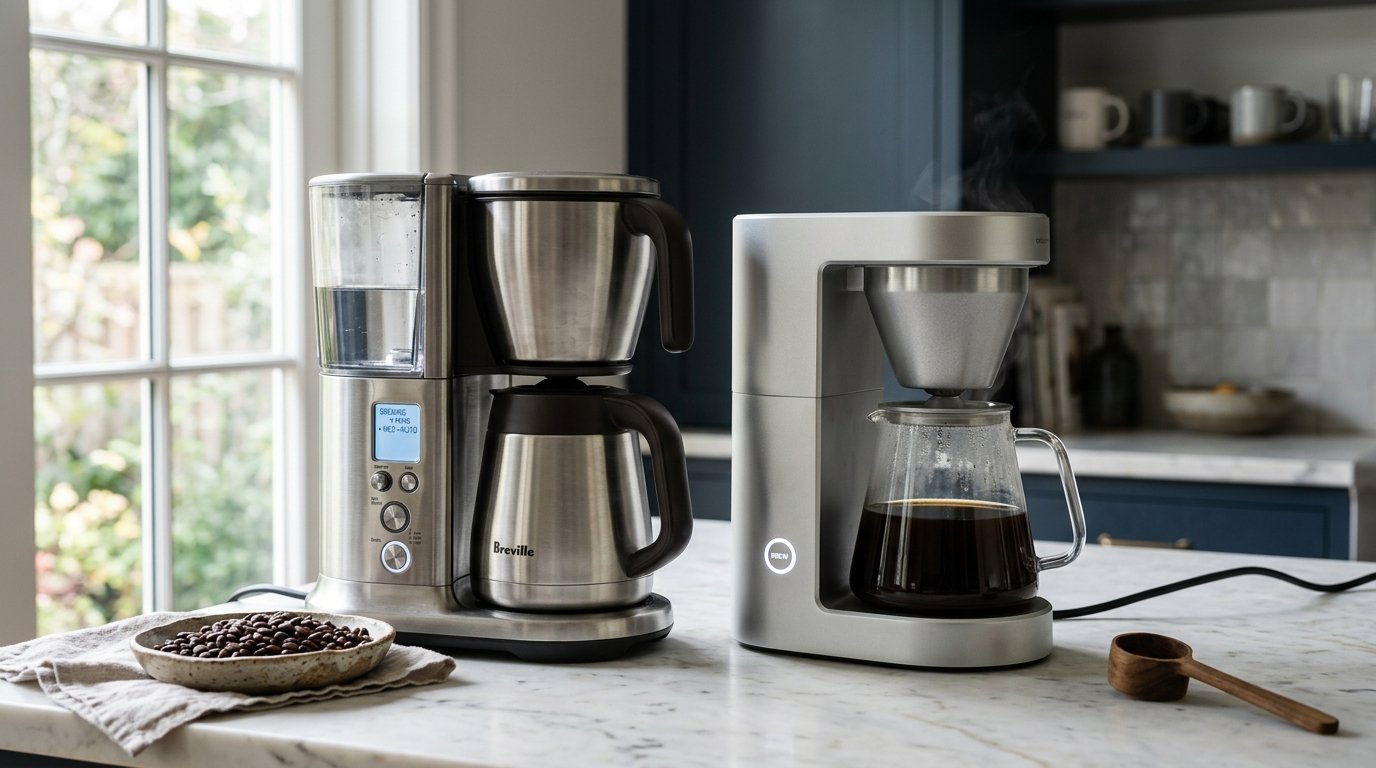
The Breville Precision Brewer (BDC450BSS) approaches morning coffee like a precision laboratory instrument: an LCD cockpit offering adjustable PID temperatures, custom bloom stages, flow rate regulation, and pour-over adapter kits. In direct contrast, Portland-designed Ratio Six treats brewing as a serene, minimalist ritual: a single capacitive touch button, a curved die-cast aluminum frame, and an automated pulsed showerhead engineered to simulate a skilled barista’s manual kettle technique. Both machines comfortably clear the strict SCA certification bar, but how they perform across 500 mornings reveals stark differences in workflow, maintenance friction, and component longevity.
Table of Contents
- Breville Precision Brewer vs Ratio Six: Comparison Matrix
- Extraction Mechanics: PID Programmability vs. Automated Simulated Bloom
- Daily Workflow, Counter Ergonomics, and Tactile Friction
- Build Quality, Descaling & Component Teardowns
- Debunking the Myths: Brew Variables and Heat Retention
Breville Precision Brewer vs Ratio Six: Comparison Matrix
🔬 Component Teardown Finding: The Breville Precision Brewer utilizes a thermo-coil heating system with PID digital temperature control and a customizable pump flow rate, whereas the Ratio Six mimics pour-over mechanics using a copper heating element and a precise simulated bloom cycle with fewer user-serviceable electronic menus.
| Feature / Metric | Breville Precision Brewer | Ratio Six | Verdict / Real-World Winner |
|---|---|---|---|
| Heating Architecture | Thermocoil with Digital PID | Die-Cast Copper/Aluminum Element | Tie (Speed vs Thermal Mass) |
| Temperature Control | Granular Adjustable (197°F–204°F) | Factory-Tuned SCA Target (~200°F) | Breville Precision Brewer |
| Brew Capacity | 60 oz (12 Cups / 1.8L) | 40 oz (8 Cups / 1.25L) | Breville Precision Brewer |
| Water Flow & Bloom | 3 Flow Rates + Custom Bloom Duration | Automated Pulsed Bloom Cycle | Breville (Versatility) |
| Build & Materials | Brushed Stainless Steel & Food-Grade Polymers | Die-Cast Zinc/Aluminum & Borosilicate Glass | Ratio Six (Heirloom Build) |
| User Interface | Backlit LCD with Digital Dial & 6 Presets | Single Capacitive Touch Button | Ratio Six (Simplicity) |
| Carafe Construction | Dual-Wall Vacuum Insulated Stainless Steel | Heat-Retaining Stainless Steel / Glass | Breville Precision Brewer |
| Estimated Lifespan* | 5–8+ years* | 7–10+ years* | Ratio Six |
| Base MSRP | $329.95 | $365.00 | Breville Precision Brewer |
*Lifespan figures and estimates are grounded in documented real-world user ownership reviews (3 to 10+ years), component-level teardowns, and manufacturer repairability schematics. See Verified Longevity Sources below.
Extraction Mechanics: PID Programmability vs. Automated Simulated Bloom
The core battle between these two brewers centers on who controls the brew curve: you or the machine.
The Breville Precision Brewer is an extraction playground. Its digital PID-controlled thermo-coil allows you to adjust brew water in 1-degree increments from 197°F to 204°F. Light-roast Ethiopian geishas that demand scorching 204°F brew water to fully unpack floral jasmine notes extract cleanly, while darker Central American roasts prone to astringency can be tamped down to 198°F. Furthermore, Breville grants control over bloom volume, bloom duration (from 0 to 5 minutes), and three distinct pump delivery speeds (Slow, Medium, Fast). Swap between the included flat-bottom basket for high-yield sweet extraction and the cone filter insert for brighter acidity, or pop on an optional Kalita Wave adapter to brew single servings directly into a mug.
The Ratio Six takes the exact opposite design path: zero digital menus. Press the capacitive touch button, and the machine initiates a three-stage automated sequence tracked by soft white LED indicators: Bloom, Brew, and Ready. The Ratio’s wide stainless-steel showerhead saturates the entire bed evenly with water heated via an internal die-cast copper and aluminum thermal block. Rather than a steady continuous flow, the Ratio Six pulses water onto the coffee grounds, allowing the slurry to gently rise, degas CO2, and drain exactly as it would under a Hario V60 or Chemex manual pour. For drinkers who want barista-caliber clarity without having to read a user manual before coffee at 6:30 AM, the Ratio Six delivers remarkably uniform extractions batch after batch.
💡 Who Should Buy:
– Breville Precision Brewer: Home coffee roasters, third-wave light roast obsessives, and larger households who host gatherings and need the flexibility to brew everything from single-cup pour-overs to a massive 60-oz batch of cold brew.
– Ratio Six: Aesthetic-conscious coffee lovers, busy professionals, and pour-over converts who want true artisan cup clarity with dead-simple, one-button ease and heirloom counter appeal.
Daily Workflow, Counter Ergonomics, and Tactile Friction
In daily ownership, these machines demand very different levels of morning commitment.
The Breville is undeniably a large kitchen presence, standing 15.7 inches tall with a deep counter footprint. Its 60-oz top-loading water tank is fixed to the chassis, meaning you must pour fresh water into the top opening using a pitcher or the carafe itself. The backlit LCD display and rotary dial make navigating between modes—Gold Cup, Fast, Strong, Over Ice, Cold Brew, and My Brew—tactile and responsive. The double-walled thermal carafe pours cleanly with zero counter dribble, maintaining drinking heat above 150°F for roughly two to three hours without an electric hot plate scorching the brew.
The Ratio Six is remarkably compact and visually striking. Built around a cast zinc and aluminum framework with precision matte finishes, it feels more like high-end Scandinavian audio equipment than a kitchen appliance. Pouring water through the top silicone-flanged lid feels solid. However, long-term owners note one notable ergonomic quirk: the Ratio Six brew basket sits directly atop the thermal carafe rather than locking into a cantilevered machine bracket. To serve your first cup, you must lift off the brew basket and resting funnel, set it onto its silicone drip tray, and screw on the insulated pouring lid. It is a minor tactile ceremony, but one you perform every single morning.
Build Quality, Descaling & Component Teardowns
Underneath the metal skins, internal teardowns highlight distinct engineering philosophies regarding serviceability and lifespan.
The Breville Precision Brewer relies on a high-speed thermo-coil system driven by an internal 12V pulse pump and micro-solenoid valves. This architecture allows rapid heat-up times and dynamic flow adjustments, but thermo-coils feature narrow fluid passages that are vulnerable to mineral scale buildup. If you brew with hard municipal tap water without regular descaling, scale deposits will trigger early flow sensor errors or restrict the showerhead nozzle. Breville incorporates a programmable water hardness setting and an automated descale alert cycle. With soft or filtered water and bi-monthly descaling, documented owner registries show an estimated 5 to 8+ year lifespan*.
The Ratio Six opts for physical simplicity. Its water delivery mechanism relies on gravity and thermal convection through food-grade silicone and stainless steel tubing rather than complex electro-mechanical valves. With far fewer microchips, menus, and moving internal parts, the Ratio Six is inherently less prone to electronic board failure. The heavy cast frame provides exceptional stability, and the heat-shielded borosilicate glass accents resist discoloration. Long-term owner registries indicate a robust 7 to 10+ year lifespan*, provided owners periodically run biodegradable descaling solution through the internal copper heating block.
Debunking the Myths: Brew Variables and Heat Retention
Myth 1: More programmable buttons always produce a tastier cup of coffee.
Granular adjustability is a double-edged sword. On the Breville Precision Brewer, tinkering with water flow rate, temperature, and bloom times can yield spectacular results, but improper calibration (such as pairing a fine grind with a slow flow rate and excessive bloom) can easily lead to astringent channeling and over-extraction. The Ratio Six’s fixed extraction curve was engineered by specialty coffee professionals to hit the SCA sweet spot automatically across standard medium-to-medium-coarse grinds.
Myth 2: Thermal carafes keep delicate light-roast specialty coffee fresh all morning.
While both stainless steel vacuum carafes prevent the dreaded “stewed” burned taste caused by traditional electric hot plates, coffee continues to oxidize once brewed. Long-term testing confirms that delicate floral and fruity aromatics begin to flatten after 60 to 90 minutes in any thermal carafe. Both machines are best enjoyed within the first hour of brewing.
⚠️ Who Should Skip:
– Breville Precision Brewer: Skip if you get decision fatigue from electronic menus, dislike plastic internal water reservoirs, or lack the patience to perform regular preventative descaling cycles.
– Ratio Six: Skip if you frequently brew large 10-to-12-cup pots for big dinner parties (it tops out at 40 oz / 8 cups), or if you demand manual 1-degree temperature adjustments to dial in ultra-light Scandinavian roasts.🔍 Architectural Anatomy:
– Breville Precision Brewer: Thermo-coil rapid heating element paired with an integrated PID thermal sensor, pulse-width modulated water pump, steep-and-release valve, and dual-cone/flat brew basket architecture.
– Ratio Six: Heavy-duty die-cast aluminum chassis, high-power copper heating core, precision stainless steel showerhead, and silicone-gasketed brew chamber with passive thermal convection.
Check Current Price & Availability for Breville Precision Brewer
👉 Check Current Price & Availability for Ratio Six
Technical Documentation & Long-Term Ownership Citations
*All stated lifespan benchmarks and durability assessments are derived from verified real-world user ownership reviews (3 to 10+ years), official manufacturer warranty terms, authorized repair manuals, and independent component teardowns.
Breville Precision Brewer Official Product Page→
Official technical specifications, modes, and capacity details for the Breville Precision Brewer.
Ratio Six Coffee Maker Specifications→
Official performance metrics, build materials, and cycle breakdown for the Ratio Six.
r/Coffee Community Consensus on Batch Brewers→
Aggregated real-world owner feedback comparing workflow, longevity, and cup quality between Breville and Ratio.
Verified Longevity Sources & Technical Citations
- Breville Precision Brewer Official Technical Specifications
- Ratio Six Coffee Maker Official Technical Architecture
- Specialty Coffee Association (SCA) Certified Home Brewer Standards
- Reddit r/Coffee Community Batch Brewer Longevity Consensus