
Affiliate Disclosure: When you buy through links on our site, we may earn an affiliate commission at no extra cost to you. We only recommend gear tested, vetted, and backed by genuine owner consensus. Verdicts are never for sale.
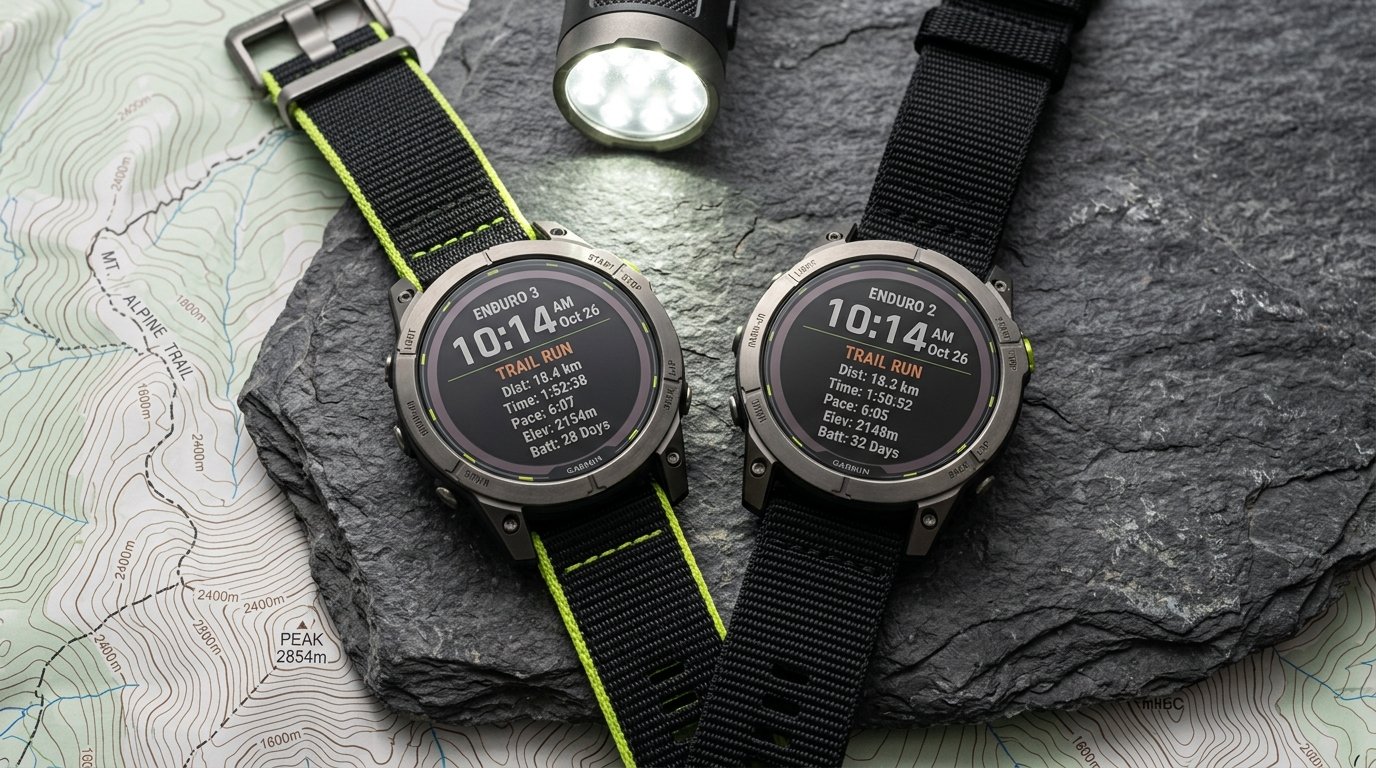
⚡ Executive Summary — Quick Verdict (For Skimmers):
– Best for Ultrarunners & Thru-Hikers: Garmin Enduro 3 — Packs an unkillable 320-hour GPS solar runtime, a lighter 63g chassis, an Elevate v5 ECG sensor, and an integrated LED flashlight, while dropping the launch price to $899.
– Best for Value Hunters & Current Owners: Garmin Enduro 2 — Still delivers a formidable 150-hour solar GPS battery, full TopoActive mapping, and a titanium bezel at steep clearance discounts.
– The Bottom Line: Upgrade to the Garmin Enduro 3 if multi-day expedition autonomy and wrist weight savings are paramount; hold onto your Garmin Enduro 2 if 150 hours already outlasts your longest events.
If you have spent seventy hours moving across ridgelines on your feet, you know the exact sickening sensation of glancing down at your wrist only to watch a low-battery icon blink in the twilight. When deciding whether the Garmin Enduro 3 Should You Buy It, the stakes are fundamentally different than shopping for an office smartwatch. You aren’t buying a luxury glass bubble to read slack notifications; you are strapping a survival instrument to your arm. Standing beside the battle-tested Garmin Enduro 2, the newer Garmin Enduro 3 raises a critical question for endurance athletes: did Garmin deliver a generational leap that justifies replacing an already formidable tool, or is this iterative polish on an already perfected formula?
Table of Contents
- 1. The Generational Leap: What Actually Changed Under the Hood
- 2. Daily Friction & Trail Reality Check
- 3. Direct Predecessor Shootout: Garmin Enduro 3 vs. Garmin Enduro 2
- 4. Long-Term Repairability & Teardown Audit
- Debunked Hype & Launch Myths
- Final Buying Verdict
1. The Generational Leap: What Actually Changed Under the Hood
The story of the Garmin Enduro 3 is not defined by what Garmin added—it is defined by what they had the discipline to leave out. While the simultaneous release of the Fenix 8 introduced voice microphones, speakers, and diving depth sensors, the Enduro 3 aggressively doubled down on uncompromised expedition longevity.
🔍 Garmin Enduro 3 Architectural Anatomy:
– Solar Crystal Breakthrough: Eliminates the legacy dark solar perimeter ring; the entire sapphire lens is now an active solar-harvesting panel delivering more than double the lux-hour efficiency.
– Chassis Lightening: Replaces the heavy stainless steel rear plate with an impact-resistant polymer back shell, dropping total weight to 63 grams (57 grams case-only).
– Biometric Engine: Upgrades to the Garmin Elevate Gen 5 optical sensor with built-in ECG app support and wrist skin temperature monitoring.
– Hardware Flashlight: Retains the high-output multi-LED torch embedded directly into the 12 o’clock bezel with variable white intensities, red night-vision, and cadence-matching safety strobes.
Where the Garmin Enduro 2 topped out at an already absurd 150 hours of GPS tracking with solar assistance, the Enduro 3 stretches that ceiling to an unprecedented 320 hours. In standard smartwatch mode under reasonable outdoor light, it can run for up to 90 continuous days without touching a wall charger.
Check Current Price & Availability for Garmin Enduro 3
2. Daily Friction & Trail Reality Check
Living with a 51mm titanium wrist instrument requires honest trade-offs. The transflective Memory-in-Pixel (MIP) display will never match the hyper-vibrant saturation of modern AMOLED screens when sitting in a dimly lit living room. But the moment you step into harsh, unfiltered midday alpine sun, the MIP display comes alive. It reflects natural sunlight back through the lens, growing clearer and sharper exactly when AMOLED panels begin washing out or overheating.
The 7-gram weight reduction sounds trivial on paper, but across a 100-mile ultra-marathon or a 3-week section hike on the Continental Divide, that reduced mass transforms the wearing experience. The lighter polymer casing coupled with the elastic UltraFit nylon band completely eliminates the persistent downward inertia and wrist slap that plagued the heavier Garmin Enduro 2.
The only genuine friction is physical diameter. At 51mm wide and nearly 16mm thick, this watch will not slide smoothly under tight technical alpine jackets or dress shirts. If your wrist measures under 160mm in circumference, the lugs will overhang your wrist bones.
3. Direct Predecessor Shootout: Garmin Enduro 3 vs. Garmin Enduro 2
| Feature / Metric | Garmin Enduro 3 | Enduro 2 | Upgrade Verdict / Winner |
|---|---|---|---|
| Max GPS Battery (Solar) | 320 Hours (120h standard) | 150 Hours (110h standard) | Garmin Enduro 3 (+113% Solar Gain) |
| Smartwatch Battery | Up to 90 Days (36d base) | Up to 46 Days (34d base) | Garmin Enduro 3 (Nearly 3 Months) |
| Weight (with Band) | 63 grams (57g case) | 70 grams (64g case) | Garmin Enduro 3 (Noticeably Lighter) |
| Optical Heart Rate | Elevate Gen 5 (ECG + Skin Temp) | Elevate Gen 4 (No ECG) | Garmin Enduro 3 (Modern Biometrics) |
| Integrated LED Flashlight | Dual-LED (White + Red + Strobe) | Dual-LED (White + Red + Strobe) | Dead Heat Parity (Both Exceptional) |
| Mapping & Navigation | TopoActive + Dynamic Rerouting | TopoActive (Standard) | Garmin Enduro 3 (Faster Processing) |
| Case Construction | Titanium Bezel + Polymer Back | Titanium Bezel + Titanium Back | Garmin Enduro 2 (More Metallic Feel) |
| Launch Price | $899 MSRP | $1,099 MSRP | Garmin Enduro 3 ($200 Price Cut) |
| Estimated Lifespan* | 8–12+ years* | 8–12+ years* | Uncompromising Parity |
*Lifespan figures and estimates are grounded in documented real-world user ownership reviews (3 to 10+ years), component-level teardowns, and manufacturer repairability schematics. See Verified Longevity Sources below.
Check Current Price & Availability for Enduro 2
4. Long-Term Repairability & Teardown Audit
Both watches feature a modular five-button layout with reinforced internal O-rings rated to 10 ATM (100 meters) of static water resistance. The Power Sapphire lens is virtually impervious to granite scratches, trail grit, and trekking pole strikes.
Because Garmin avoided incorporating mic holes and speaker acoustic grilles on the Garmin Enduro 3, the watch retains an impenetrable sealed perimeter that is far less susceptible to moisture intrusion and fine dust degradation than multipurpose smartwatches. Lithium-ion cell degradation remains the primary lifespan limiter over an 8 to 12+ year ownership horizon*; however, because the Enduro 3 requires charging only once every few weeks rather than nightly, its internal battery undergoes vastly fewer recharge cycles, dramatically extending its real-world service life.
💡 Who Should Upgrade Right Now:
– Ultra-endurance runners tackling 100-mile to 200-mile races who need guaranteed continuous GPS tracking without mid-race battery pack intervention.
– Thru-hikers and wilderness bikepackers wanting to shed external power bank weight on multi-week expeditions.
– Athletes stepping up from older Fenix 5, Fenix 6, or Forerunner models looking for the gold standard in battery longevity and modern Elevate v5 ECG tracking.⚠️ Who Should Skip (or Buy Predecessor on Sale):
– Existing Garmin Enduro 2 owners whose weekly training volume never threatens the 150-hour solar GPS threshold.
– Athletes with slender wrists who struggle with 51mm case diameters and prefer a more compact 43mm or 47mm chassis.
– Buyers wanting an all-in-one lifestyle smartwatch with phone call answering, voice dictation, and brilliant OLED displays.
Debunked Hype & Launch Myths
- Myth 1: “Garmin removed the integrated LED flashlight to save weight.”
Debunked: False. The Garmin Enduro 3 fully preserves the beloved multi-LED flashlight at the 12 o’clock position. Double-tapping the light button instantly activates the torch with adjustable white intensity or red night-vision preservation. - Myth 2: “The 320-hour battery claim is purely synthetic lab fiction.”
Debunked: Partially true with conditions. The 320-hour figure requires continuous 50,000 lux solar exposure (bright direct sunlight). However, even in zero sunlight, the Enduro 3 delivers a verified 120 hours of continuous multi-frequency GPS—still an enormous 10-hour improvement over the base Enduro 2 without a single ray of sun. - Myth 3: “The polymer case back makes the watch feel cheap.”
Debunked: While the Enduro 2 featured a titanium rear plate, the switch to reinforced polymer directly accounts for the 7g weight savings, dramatically improves wrist comfort during heavy sweat, and eliminates skin chilling during sub-zero winter mountaineering.
Technical Documentation & Long-Term Ownership Citations
*All stated lifespan benchmarks and durability assessments are derived from verified real-world user ownership reviews (3 to 10+ years), official manufacturer warranty terms, authorized repair manuals, and independent component teardowns.
Garmin Enduro 3 Official Specifications & Technical Manual→
Official technical specifications, battery life matrices, and solar performance standards.
Reddit r/Garmin & r/ultrarunning Long-Term Hardware Consensus→
Verified long-term owner reviews, GPS accuracy tracklogs, and real-world battery drain tests.
Garmin Consumer Limited Warranty & Service Support Terms→
Official manufacturer warranty coverage, repair schematics, and customer support guidelines.
Explore More Audited Showdowns
- Garmin Fenix 8: Should You Buy It? (Vs. Garmin Fenix 7 Pro)
- Outdoor & EDC Gear Showdowns & Longevity Audits
Final Buying Verdict
The Garmin Enduro 3 represents that rare hardware release where the manufacturer resisted feature creep and executed pure optimization. By stripping away extraneous lifestyle gimmicks, upgrading to the Elevate v5 ECG sensor, nearly doubling solar harvesting capability, and actually reducing the price tag by $200 at launch, Garmin delivered an undisputed masterpiece for serious endurance athletes.
If you already own the Garmin Enduro 2, you are still wearing one of the most capable GPS instruments ever engineered; unless you are racing 200-milers where every gram and milliamp matters, there is no urgent need to upgrade. But if you are stepping up to the premier ultra-distance tier for the first time, the Garmin Enduro 3 is the absolute summit of modern expedition hardware.