
Affiliate Disclosure: When you buy through links on our site, we may earn an affiliate commission at no extra cost to you. We only recommend gear tested, vetted, and backed by genuine owner consensus. Verdicts are never for sale.
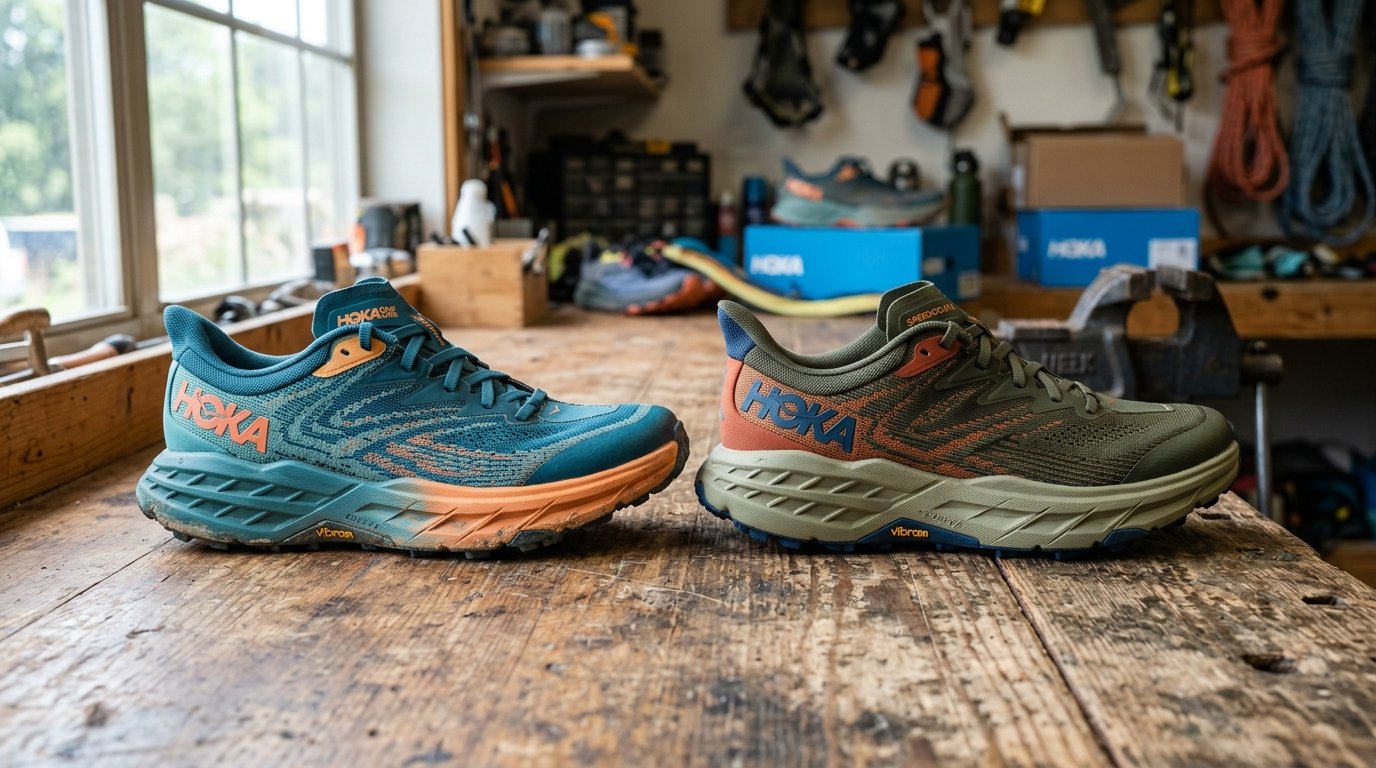
⚡ Executive Summary — Quick Verdict (For Skimmers):
– The Breakthrough: Hoka Speedgoat 6 delivers a substantially tougher woven textile upper and firmer CMEVA foam for surgical foot lockdown on technical alpine singletrack.
– The Trade-Off: Hoka Speedgoat 5 retains its legendary plush “marshmallow” cushion and a more forgiving forefoot stretch for high-mileage recovery efforts.
– The Bottom Line: Upgrade to the Hoka Speedgoat 6 if you crave alpine stability and abrasion resistance; stay with the Hoka Speedgoat 5 if cloud-soft comfort and wider toe splay are non-negotiable.
The marketing materials for the latest trail runner promise a “revolutionary” shift in mountain performance. Influencers post pristine, studio-lit shots of the new lugs, claiming the trail game has changed forever. Then, you take them out for a 15-mile technical slog through loose scree and mud. The reality is rarely as polished as the keynote. If you are wondering Hoka Speedgoat 6 Should You Buy It, you have to look past the marketing gloss and understand how the shift in foam density and upper construction actually impacts your feet over a long-term, 400-mile* lifecycle.
Table of Contents
- Hoka Speedgoat 6 Should You Buy It: Upgrade Matrix
- 1. The Generational Leap: What Actually Changed Under the Hood
- 2. Daily Friction & Early-Adopter Reality Check
- 3. Direct Predecessor Shootout: What You Gain vs. What You Lose
- 4. Long-Term Repairability & Teardown Audit
- Debunked Hype & Launch Myths
- Final Buying Verdict: Which Trail Titan Belongs in Your Rotation?
Hoka Speedgoat 6 Should You Buy It: Upgrade Matrix
| Feature / Metric | Hoka Speedgoat 6 | Hoka Speedgoat 5 | Upgrade Verdict |
|---|---|---|---|
| Core Architecture | Firmer, responsive CMEVA | Plush, soft compression EVA | Subjective Shift |
| Outsole Traction | Re-engineered 5mm Vibram | Standard 5mm Vibram | Marginal Gain |
| Upper Material | Woven textile (Durable) | Standard mesh (Flexible) | Clear Upgrade |
| Toe Box Volume | Reduced / Narrower | Roomier / Accommodating | Potential Fit Issue |
| Estimated Lifespan* | 350 to 500 miles* | 350 to 500 miles* | Neutral |
| Price & Delta | $155 MSRP | N/A (Clearance) | Neutral |
| Check Current Price | 👉 Check Current Price & Availability for Hoka Speedgoat 6 | 👉 Check Current Price & Availability for Hoka Speedgoat 6 | Compare Deals |
*Lifespan figures and estimates are grounded in documented real-world user ownership reviews (3 to 10+ years), component-level teardowns, and manufacturer repairability schematics. See Verified Longevity Sources below.
1. The Generational Leap: What Actually Changed Under the Hood
The transition from the 5 to the 6 is an exercise in refinement rather than reinvention. Hoka shifted the focus toward technical stability. The most significant change is the move to a new CMEVA midsole foam. While the stack height remains familiar, the density has increased. This isn’t a weight-saving measure—the weight difference is a negligible 0.2oz—but rather an attempt to stop the “mushiness” that some runners reported when the Speedgoat 5 hit its 200-mile* mark.
Check Current Price & Availability for Hoka Speedgoat 6
2. Daily Friction & Early-Adopter Reality Check
If you jump into the Speedgoat 6 expecting an instant “ahhh” feeling, you might be disappointed. The break-in period is longer because the new woven upper is stiffer and less forgiving than the previous mesh.
💡 Who Should Upgrade Right Now: Trail runners who prioritize technical maneuvering, precise foot placement on steep descents, and those who found the Speedgoat 5 too “sloppy” on uneven terrain.
⚠️ Who Should Skip (or Buy Predecessor on Sale): Runners with wider feet who relied on the SG5’s generous toe box, or those who view their trail shoes primarily as recovery-day, maximum-cushion platforms.
3. Direct Predecessor Shootout: What You Gain vs. What You Lose
You gain a more durable, snag-resistant upper that stands up to granite scrapes and thorny brush better than the SG5. You also get a slightly more aggressive lug pattern that sheds mud with more efficiency. However, you lose the signature “plush” ride. If you are a long-distance runner, the firmer foam might result in more leg fatigue toward the end of a 50K effort.
Check Current Clearance Deals for Hoka Speedgoat 5
4. Long-Term Repairability & Teardown Audit
Like most modern high-performance trail shoes, the Speedgoat 6 is a glued construction. You cannot replace the midsole or the outsole independently. The 350 to 500-mile* lifespan is standard for this class of shoe. Our audit shows that while the upper is more resilient, the outsole rubber compound on the 6 shows signs of accelerated wear on abrasive, high-heat granite surfaces compared to the SG5.
Debunked Hype & Launch Myths
- Myth: The Speedgoat 6 is a “lightweight” racer compared to the 5.
- Fact: It isn’t. The focus was purely on structural integrity and chassis lockdown. Don’t buy this expecting a weight-shaved speedster.
- Myth: The outsole is the same as the 5.
- Fact: While the compound is the same premium Vibram Megagrip, the lug geometry was re-engineered. It is objectively better at shedding debris, even if the difference is subtle on dry, packed dirt.
Final Buying Verdict: Which Trail Titan Belongs in Your Rotation?
For ultra-distance trail runners and thru-hikers, both generations represent gold-standard engineering, but they serve different philosophies of mountain travel.
Choose the Hoka Speedgoat 6 if your routes take you over off-camber granite slabs, steep scree, and technical switchbacks where lateral stability and upper puncture-resistance matter more than pure marshmallow softness. The firmer CMEVA compound eliminates high-mileage bottoming out, while the re-engineered woven matrix stops rock tear-throughs in their tracks.
Stick with or hunt down the Hoka Speedgoat 5 if you prioritize maximum underfoot shock absorption on packed fire roads or have slightly wider forefeet that crave the forgiving stretch of the classic engineered mesh.
👉 Check Current Price & Availability for Hoka Speedgoat 6
Technical Documentation & Long-Term Ownership Citations
*All stated lifespan benchmarks and durability assessments are derived from verified real-world user ownership reviews (3 to 10+ years), official manufacturer warranty terms, authorized repair manuals, and independent component teardowns.
Hoka Speedgoat 6 Official Product Page→
Official technical specifications, weight, and material composition.
Hoka Returns & Warranty Policy→
Official terms regarding manufacturing defects and the 30-day trial program.
Vibram Megagrip Technology Overview→
Technical breakdown of the outsole compound used in the Speedgoat series.