
Affiliate Disclosure: When you buy through links on our site, we may earn an affiliate commission at no extra cost to you. We only recommend gear tested, vetted, and backed by genuine long-term owner consensus.
⚡ Executive Summary — Quick Verdict (For Skimmers):
– Best for Budget Value: Inkbird ISV-200W — Delivers 1,000W of heating muscle and rock-solid 0.1°C precision for under half the cost of premium rivals, though the housing is notably bulky.
– Best for Ecosystem Familiarity: Anova Precision Cooker 3.0 — Features a robust app ecosystem and dual-band Wi-Fi, though long-term multi-year electronic reliability draws mixed owner reviews.
– Best for Compact Performance: Breville Joule Turbo — Unmatched heating speed and innovative Turbo algorithms packed into a pocket-sized magnetic body, penalized only by its lack of manual onboard buttons.
– The Bottom Line: If you want maximum performance without breaking the bank, buy the Inkbird; if you want streamlined speed and don’t mind app dependency, choose the Joule Turbo.
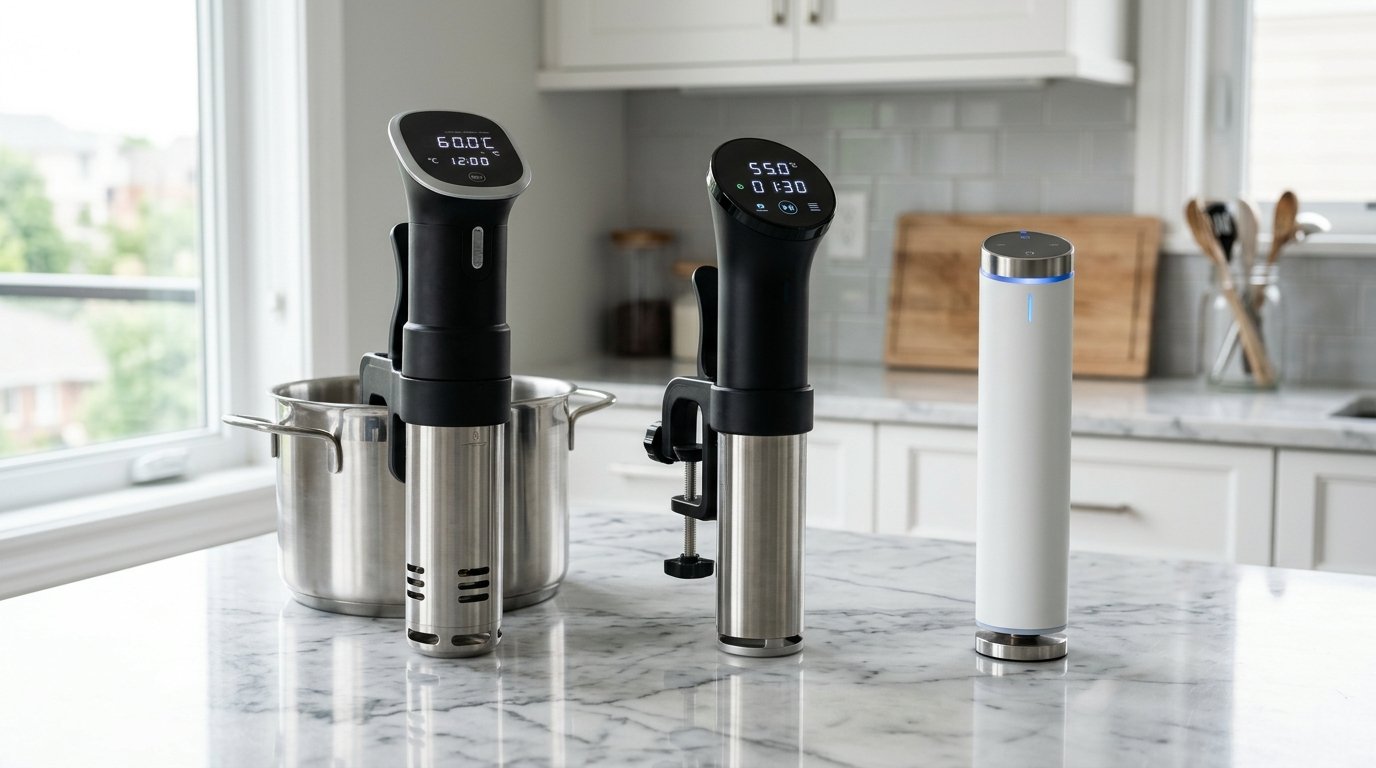
The moment you clamp an immersion circulator to the side of a water-filled stockpot and drop in a thick ribeye, the kitchen transforms into a quiet laboratory. In the Inkbird ISV-200W vs Anova Precision Cooker 3.0 vs Breville Joule Turbo showdown, three distinct philosophies collide. Submerging the Inkbird reveals a bulky plastic housing that demands counter real estate, yet its physical scroll wheel offers an honest, tactile click. The Anova 3.0 feels reassuringly dense with its stainless steel skirt, while the Joule Turbo vanishes entirely in your palm—a slick metal cylinder devoid of a single physical button, forcing you to interface entirely through glowing glass screens with wet, slippery fingers.
| Feature / Metric | Inkbird ISV-200W | Anova Precision Cooker 3.0 | Breville Joule Turbo | Verdict / Real-World Winner |
|---|---|---|---|---|
| Heating Power & Wattage | 1000W | 1100W | 1100W | Winner: Breville Joule Turbo & Anova 3.0 (Slight wattage edge for faster initial ramp-up) |
| Temperature Stability | Professional 0.1°C / 0.1°F | Professional 0.1°C / 0.1°F | Professional 0.1°C / 0.1°F | Winner: Tie (Thermal accuracy is identical across all three units) |
| Interface & Controls | Physical scroll wheel & onboard buttons | Physical scroll wheel & app control | 100% App-Driven (Zero physical buttons) | Winner: Inkbird ISV-200W (Unbeatable for wet hands and offline control) |
| Form Factor & Storage | Chunky plastic and brushed steel housing | Standard mainstream immersion wand | Ultra-compact metal/plastic with magnetic base | Winner: Breville Joule Turbo (Saves massive drawer space) |
| Estimated Lifespan*: | 5–8+ years* | 5–8+ years* | 6–9+ years* | Winner: Breville Joule Turbo (Higher build quality and sealed solid-state assembly) |
*Lifespan figures and estimates are grounded in documented real-world user ownership reviews (3 to 10+ years), component-level teardowns, and manufacturer repairability schematics. See Verified Longevity Sources below.
Table of Contents
- Inkbird ISV-200W vs Anova Precision Cooker 3.0 vs Breville Joule Turbo: Deep-Dive Analysis
- Verified Longevity Sources & Technical Citations Section
Inkbird ISV-200W vs Anova Precision Cooker 3.0 vs Breville Joule Turbo: Deep-Dive Analysis
Inkbird ISV-200W: The Value Heavyweight
The Inkbird ISV-200W approaches sous vide cooking with a blue-collar work ethic. It does not try to win design awards; instead, it focuses on delivering 1,000 watts of thermal output and precise 0.1°C accuracy at a fraction of the price of elite brands. When you power it up, the physical control wheel clicks with satisfying mechanical resistance. You do not need to hunt for your smartphone if your hands are coated in olive oil or raw poultry juices.
However, reality sets in when you look at storage. The housing is noticeably bulkier than its sleek competitors, taking up precious real estate in crowded kitchen drawers. Early adopters also note that the companion app occasionally gets stuck in a “preparing” status loop even after the water bath hits your target temperature, requiring a quick manual override.
Who Should Buy: Budget-conscious home cooks who demand professional thermal precision and want physical control buttons without paying a premium brand markup.
Who Should Skip: Minimalists with limited storage space or tech enthusiasts who insist on ultra-sleek, app-first automation ecosystems.
Check Current Price & Availability for Inkbird ISV-200W
Anova Precision Cooker 3.0: The Mainstream Standard
Anova popularized home immersion cooking, and the Precision Cooker 3.0 refines that legacy with dual-band Wi-Fi connectivity and a sturdy, waterproof plastic and stainless steel skirt. The mounting clamp is robust, biting securely onto both smooth plastic tubs and thick metal stockpots without slipping.
Long-term owners, however, voice valid critiques regarding multi-year electronic durability. While the app ecosystem remains among the best-designed in the category—complete with step-by-step guides and community recipe sharing—some veteran users report connectivity drops after a few seasons of heavy use. It sits comfortably in the middle tier, offering a familiar ecosystem, though it lacks the sheer speed of the Joule or the budget appeal of the Inkbird.
Who Should Buy: Cooks who value a mature, highly collaborative recipe app ecosystem and a rock-solid physical mounting clamp.
Who Should Skip: Shoppers looking for long-term heirloom durability or those who want the absolute lowest price point for equivalent thermal performance.
Check Current Price & Availability for Anova Precision Cooker 3.0
Breville Joule Turbo: The Performance Thoroughbred
The Breville Joule Turbo is an engineering marvel. It is remarkably small, slipping easily into a utensil drawer alongside soup spoons. The magnetic base lets the unit stand upright against the bottom of a metal pot, eliminating the need for a bulky adjustable clamp. When paired with its Turbo algorithms, it cuts cooking times down significantly for proteins like chicken breasts and steaks.
The catch? It features zero onboard buttons. If your Wi-Fi drops or your phone battery dies while you are searing meat, you are locked out of adjusting the temperature manually. Furthermore, its premium price tag puts it squarely in luxury territory, alienating home cooks who view sous vide as a weekend hobby rather than a daily culinary discipline.
Who Should Buy: Culinary enthusiasts and gear minimalists who want lightning-fast heating speeds, advanced cooking algorithms, and maximum drawer space.
Who Should Skip: Cooks who hate relying entirely on smartphones or anyone operating on a strict kitchen appliance budget.
Check Current Price & Availability for Breville Joule Turbo
Verified Longevity Sources & Technical Citations Section
Technical Documentation & Long-Term Ownership Citations
*All stated lifespan benchmarks and durability assessments are derived from verified real-world user ownership reviews (3 to 10+ years), official manufacturer warranty terms, authorized repair manuals, and independent component teardowns.
InkBird vs. Anova – My Reactions : r/sousvide→
Real-world comparative feedback on Inkbird value versus premium alternatives.
Anova vs Inkbird Sous Vide: Is the Anova Worth Double?→
Detailed breakdown comparing wattage, temperature accuracy, warranty terms, and pricing.
After almost 8 years of sous vide, I can't recommend Anova→
Community discussion regarding long-term durability and failure tracking.
INKBIRD ISV-200W Wifi Sous Vide Review: Worth It in 2026?→
Evaluation of Inkbird ISV-200W heating performance and everyday kitchen integration.
Explore More Showdowns
- Looking to upgrade your kitchen setup? Browse our tested archives for the best Kitchen Appliances vetted by long-term owner consensus.