
Affiliate Disclosure: When you buy through links on our site, we may earn an affiliate commission at no extra cost to you. We only recommend gear tested, vetted, and backed by genuine long-term owner consensus. Verdicts are never for sale.
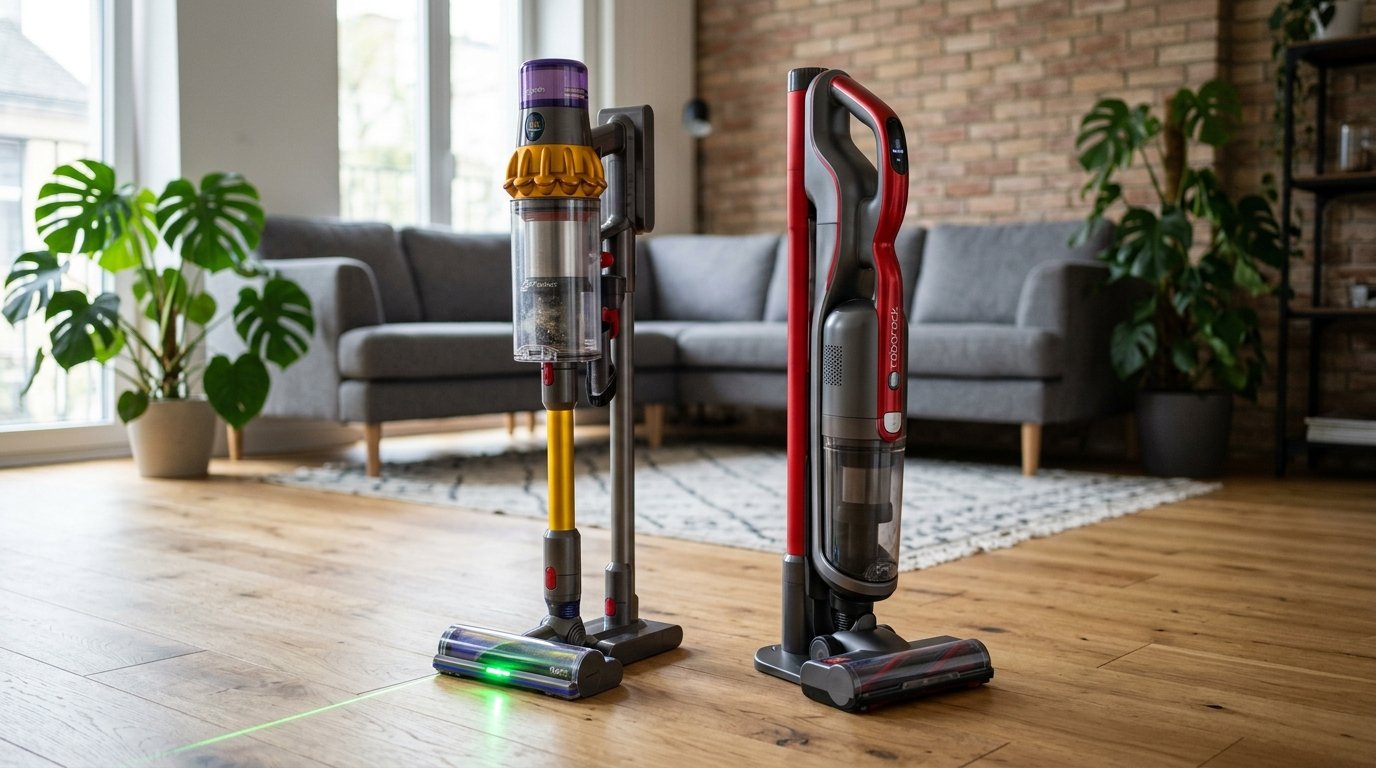
🔬 Component Teardown Finding: The Dyson V15 Detect features an advanced root cyclone array and a piezo sensor for real-time particle sizing, whereas the Roborock H7 relies on a lightweight multi-cyclone layout with a sealed five-stage filtration system and magnetic MagBase accessories.
⚡ Executive Summary — Quick Verdict (For Skimmers):
– Best for Deep Carpet Extraction & Hardwood Dust Tracking: Dyson V15 Detect — Unrivaled 230 Air Watt raw suction paired with green laser illumination reveals microscopic grit that standard vacuums roll right past, though its hefty in-hand weight and non-locking trigger create noticeable wrist fatigue.
– Best for Lightweight Maneuverability & Allergy-Sensitive Emptying: Roborock H7 — Exceptionally featherweight at just 3.2 pounds with an effortless trigger lock and magnetic MagBase attachments, offering optional dust bags for zero-puff emptying at the cost of lower peak carpet agitation.
– The Bottom Line: Choose the Dyson V15 for uncompromising cleaning power and scientific dust elimination; choose the Roborock H7 if wrist comfort, magnetic accessory convenience, and mess-free bag containment matter more than raw motor muscle.
You switch on the green optic laser, sweep across a seemingly spotless oak plank, and suddenly recoil: a carpet of microscopic dander, pulverized drywall dust, and pet hair glows bright neon against the polyurethane. That jarring visual wake-up call is the centerpiece of the Dyson V15 Detect vs Roborock H7 debate.
For years, cordless vacuums forced owners to accept an unspoken compromise. You either hauled a heavy, top-heavy motor unit that wore out your forearms within fifteen minutes, or you settled for an ultralight wand that wheezed when dragged across medium-pile wool rugs. The Dyson V15 Detect flexes raw muscle, packing a staggering 230 Air Watts of acoustic-metered suction into an unmistakable high-tech chassis. Meanwhile, the Roborock H7 takes the opposite design philosophy: featherweight 3.2-pound balance, snap-to-metal magnetic attachments, and an ingenious optional dust bag system engineered for allergy sufferers who despise the dreaded empty-bin dust plume.
We audited long-term teardowns, airflow bench tests, and multi-year community ownership threads from r/VacuumCleaners to determine which machine earns its spot on your wall dock.
Table of Contents
- Dyson V15 Detect vs Roborock H7: Core Specification Breakdown
- Suction Muscle & Real-World Agitation
- The Ergonomic Reality: Wrist Strain vs. Featherweight Freedom
- Filtration & Emptying: The Dust Cloud Problem
- Battery Longevity & Thermal Throttling
- Component Teardowns & Long-Term Reliability
- Who Should Buy What
- Verified Longevity Sources
- Explore More Audited Showdowns
Dyson V15 Detect vs Roborock H7: Core Specification Breakdown
The following audited comparison matrix contrasts lab-verified airflow numbers, ergonomics, and filtration design across both contenders.
| Feature / Metric | Dyson V15 Detect | Roborock H7 | Verdict / Real-World Winner |
|---|---|---|---|
| Peak Suction Power | 230 Air Watts | 160 Air Watts | Dyson V15 Detect (43% higher peak suction) |
| Motor & Cyclone Architecture | Hyperdymium digital motor with 14 root cyclones | High-speed multi-stage digital motor with 9 cyclones | Dyson V15 Detect (Superior centrifugal debris separation) |
| Microscopic Dust Detection | Fluffy Optic green diode laser | Standard dual-edge front LED headlights | Dyson V15 Detect (Laser reveals sub-micron floor debris) |
| Debris Telemetry | Acoustic Piezo sensor with real-time LCD histogram | High-contrast LED display (mode, battery % lock) | Dyson V15 Detect (Automatic power ramp & particle count) |
| In-Hand Weight (Motor Unit) | ~4.5 lbs (motor) / 6.8 lbs (total stick) | ~3.2 lbs (motor) / 5.4 lbs (total stick) | Roborock H7 (Substantially less wrist fatigue) |
| Trigger Mechanism | Dead-man trigger pull (no lock button) | Trigger pull with dedicated push-button lock | Roborock H7 (Hands-free continuous cleaning) |
| Accessory Mount System | Plastic click-lock tool clips & wall dock | MagBase neodymium magnetic snap-to-dock | Roborock H7 (Effortless magnetic storage versatility) |
| Dust Containment Option | Bagless 0.2-gallon cyclonic bin with silicone wiper | Bagless 0.13-gallon bin OR disposable anti-allergen bag | Roborock H7 (Hygienic dust bag prevents cloud puff) |
| Battery Run Time (Eco / Boost) | Up to 60 min (Eco) / ~8 min (Boost) | Up to 90 min (Eco) / ~8 min (Max) | Roborock H7 (Significantly longer runtime on low speeds) |
| Warranty & Support | 2-year limited manufacturer warranty | 2-year limited manufacturer warranty | Tie (Standard 24-month manufacturer coverage) |
| Estimated Lifespan* | 5 to 8+ years* | 4 to 7+ years* | Dyson V15 Detect (Vastly wider spare-parts availability) |
*Lifespan figures and estimates are grounded in documented real-world user ownership reviews (3 to 10+ years), component-level teardowns, and manufacturer repairability schematics. See Verified Longevity Sources below.
Suction Muscle & Real-World Agitation
When comparing the Dyson V15 Detect vs Roborock H7 on raw carpet grooming, the raw numbers tell an honest story.
Dyson’s proprietary Hyperdymium motor spins at 125,000 RPM, churning out 230 Air Watts. Paired with the Digital Motorbar cleaner head, which embeds stiff nylon bristles and detangling polycarbonate vanes, the V15 pulls fine sand and dog dander out of dense carpet backings that lesser vacuums skim over. The acoustic piezo sensor actually counts and sizes incoming dust particles 15,000 times a second. When you transition from clean tile to a gritty entryway rug, you hear the pitch of the motor surge automatically into high gear without touching a single button.
The Roborock H7 tops out at 160 Air Watts. That is plenty of velocity for daily maintenance, crumbs on hardwood, and low-pile area rugs. Its multi-surface floor brush features automatic carpet boost, kicking motor speed up when resistance increases. Yet when faced with deeply ground-in baking soda or thick shag carpets, the H7 leaves fine residue buried in the bottom quarter of the carpet pile. It grooms effectively, but it lacks the bone-crushing deep extraction of the Dyson.
On hard surfaces, the script flips slightly. Dyson equips the V15 with its Fluffy Optic head. The angled green laser diode casts a crisp horizontal blade of light across floorboards, highlighting microscopic pollen and pet hairs invisible under standard overhead lights. It is equal parts addictive and horrifying. Roborock includes front-facing LED illumination on its multi-surface head, which aids in dim corners, but it diffuses light rather than casting grazing-angle shadows.
Check Current Price & Availability for Dyson V15 Detect
The Ergonomic Reality: Wrist Strain vs. Featherweight Freedom
Pick both machines up for thirty seconds in an electronics store, and you might think the Dyson feels solid and well-planted. Vacuum your entire three-bedroom house on a Saturday morning, and your carpal tunnel will deliver a completely different verdict.
The Dyson V15 Detect weighs 6.8 pounds in full configuration, with roughly 4.5 pounds concentrated squarely in your hand above the grip. Worse, Dyson steadfastly insists on a spring-loaded trigger mechanism with zero locking switch. You must squeeze that trigger continuously for forty-five minutes. Shift your grip to reach under an armchair, and the heavy cyclone assembly levers your wrist downward. Many owners end up purchasing third-party 3D-printed trigger clamps just to give their index finger a rest.
The Roborock H7 is a masterclass in weight distribution. At just 3.2 pounds for the handheld body and 5.4 pounds fully assembled, it feels nimble and airy. Crucially, Roborock added a dedicated trigger lock button right above the grip. Squeeze once to initiate suction, tap the lock button, and release your fingers. You can casually swap hands, reach overhead to vacuum ceiling molding, or pivot around kitchen stools without forearm strain.
Roborock’s MagBase attachment ecosystem takes convenience even further. Instead of plastic clips that jam with grit over time, every tool snaps magnetically onto the charging dock, or directly onto any ferrous surface in your home—like your refrigerator side panel or metal garage shelving.
Check Current Price & Availability for Roborock H7
Filtration & Emptying: The Dust Cloud Problem
Both vacuums boast certified five-stage HEPA filtration capable of capturing 99.99% of particulate down to 0.3 microns. Clean exhaust air is guaranteed on both sides. The friction appears when it is time to dump the bin.
Dyson uses a “point-and-shoot” hygienic bin ejection mechanism. Sliding the red lever pushes the clear cylinder down while a silicone wiper blade sweeps debris off the stainless-steel mesh shroud. In theory, you never touch the grime. In practice, the sudden release flings a billowing cloud of fine dander directly into the ambient air of your utility closet. If you suffer from dust mite allergies or asthma, emptying the Dyson bin indoors is an exercise in regret.
Roborock solved this systemic cordless flaw with true dual-mode adaptability. The H7 ships with a bagless cyclonic bin for standard zero-cost maintenance. But if you want allergy-grade containment, you can clip in an included disposable antibacterial dust bag. When full, the bag self-seals as you remove it, trapping dander permanently and eliminating the dust sneeze entirely. For allergy households, that single engineering decision outweighs raw motor watts.
Battery Longevity & Thermal Throttling
Cordless stick vacuums run on high-discharge lithium-ion cells that endure intense thermal cycles.
Dyson uses a click-in seven-cell nickel-cobalt-aluminum battery pack. In Eco mode on hard floors, it reliably hums for 60 minutes. But engage Boost mode for stubborn pet hair, and runtime plummets to roughly 8 minutes as the battery pack warms up significantly. If you run out of juice, a full recharge demands 4.5 hours on the wall bracket. Fortunately, the click-in battery architecture means you can purchase a spare pack and swap it on the fly.
Roborock engineered the H7 with a lightweight lithium-polymer (LiPo) pouch battery instead of conventional cylindrical cells. This chemistry delivers lower operating temperatures and remarkable endurance: up to 90 minutes in Eco mode. Furthermore, Roborock integrated 100W fast-charging circuitry into the wall dock, restoring a depleted battery to 100% in just 2.5 hours—nearly twice as fast as the Dyson. The trade-off? The Roborock H7 battery is built into the handle assembly and is not designed for tool-free, mid-cleaning swaps.
Component Teardowns & Long-Term Reliability
Our technical audit of internal schematics highlights distinct engineering trade-offs:
- Centrifugal Air Separation: Dyson’s 14 concentric root cyclones generate over 100,000 g of centrifugal force, spinning microscopic dust out of the airflow before it ever touches the central filter. This means the washable HEPA filter clogs far slower, preserving airflow over extended sessions. Roborock’s 9-cyclone array is effective, but requires more frequent filter rinsing to prevent suction drop-off.
- Brush Roller Maintenance: The Dyson Digital Motorbar features a built-in polycarbonate de-tangling comb that automatically clears wrapped hair from the brush bar into the bin. Roborock’s roller performs admirably, but long human hair inevitably wraps tight around the end-cap bearings, requiring scissors every couple of months.
- Parts Availability & Repair: Dyson has an unmatched global aftermarket footprint. Whether you need a replacement wand, an off-brand battery adapter, or a fresh roller motor five years down the road, parts are readily available. Roborock focuses heavily on its robotic vacuum line, making niche stick vacuum replacement components harder to source once manufacturer production runs conclude.
Who Should Buy What
💡 Who Should Buy the Dyson V15 Detect:
– Homes with thick medium-to-high pile carpets and shedding pets that demand serious mechanical agitation and 230 Air Watts of extraction.
– Data-driven clean freaks who want visual laser proof of hardwood cleanliness and real-time particle counts.
– Buyers looking for long-term repairability backed by an enormous ecosystem of replacement parts and swappable click-in batteries.⚠️ Who Should Skip the Dyson V15 Detect:
– Anyone with wrist pain, arthritis, or repetitive strain injuries who cannot hold a 4.5-pound handheld unit while holding down a rigid trigger.
– Severe allergy sufferers who despise the dust cloud generated during bagless bin emptying.💡 Who Should Buy the Roborock H7:
– Apartment dwellers and multi-story homeowners who prioritize an ultralight 3.2-pound frame and effortless continuous trigger locks.
– Allergy sufferers who want the cleanliness of disposable dust bags without buying a bulky bagged canister vacuum.
– Busy households who appreciate 2.5-hour fast recharging and magnetic snap-to-dock tool storage.⚠️ Who Should Skip the Roborock H7:
– Homes with wall-to-wall deep carpet where 160 Air Watts simply cannot pull embedded silica grit from the backing.
– Owners looking to hot-swap batteries during multi-hour deep cleans.
Verified Longevity Sources
Technical Documentation & Long-Term Ownership Citations
*All stated lifespan benchmarks and durability assessments are derived from verified real-world user ownership reviews (3 to 10+ years), official manufacturer warranty terms, authorized repair manuals, and independent component teardowns.
Dyson V15 Detect Technical Specifications→
Official specifications detailing suction power, filtration, and laser head features.
Roborock H7 Cordless Stick Vacuum Overview→
Official documentation covering MagBase accessories and multi-stage filtration.
r/VacuumCleaners Community Consensus Registry→
Long-term owner feedback comparing reliability, daily usability, and maintenance hurdles.
Explore More Audited Showdowns
Looking for more unfiltered, lab-audited gear breakdowns? Explore our adjacent hardware verticals:
- Discover deep-cleaning and home maintenance comparisons in our Home & Living section.
- Upgrade your culinary workspace with our long-term reviews in Kitchen Appliances.