
Affiliate Disclosure: When you buy through links on our site, we may earn an affiliate commission at no extra cost to you. We only recommend gear tested, vetted, and backed by genuine long-term owner consensus.
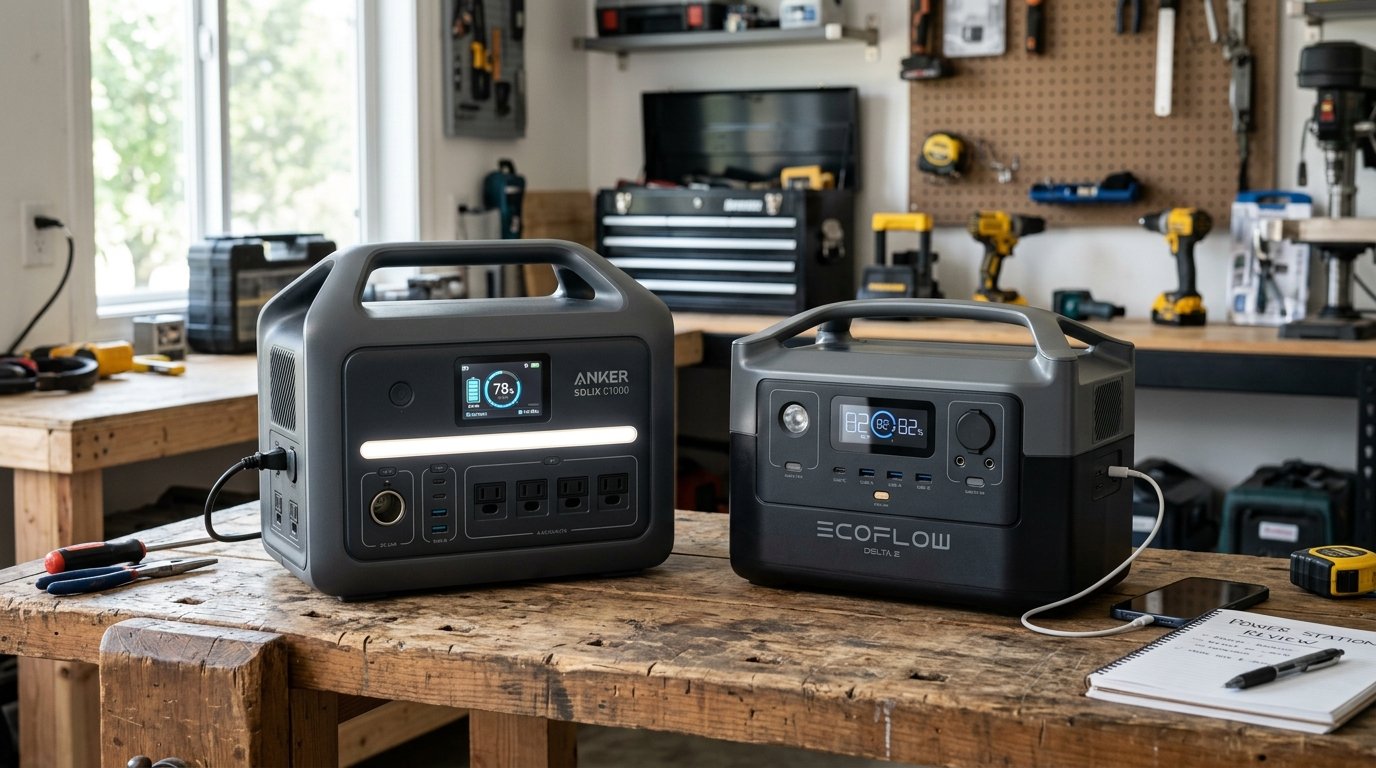
⚡ Executive Summary — Quick Verdict (For Skimmers):
– Best for Speed & Simplicity: Anker SOLIX C1000 — Delivers blistering 58-minute AC recharging and a dense, monolithic build, though continuous output caps slightly lower at 1800W.
– Best for Expandability: EcoFlow DELTA 2 — Offers modular capacity scaling up to 3040Wh with extra batteries and higher surge handling via X-Boost, but struggles with louder fan noise under heavy loads.
– The Bottom Line: If you want lightning-fast standalone wall charging and rugged simplicity, choose the Anker; if you need future-proof capacity expansion for extended off-grid stays, go with the EcoFlow.
The tactile click of a heavy-duty rocker switch flipping on under a sudden grid failure carries a very distinct kind of reassurance. Moments before, your workspace hummed along normally; now, absolute silence, save for the frantic beep of a desktop dying mid-save. Dropping a portable power station onto the concrete garage floor or wrestling a tangle of 12-gauge solar cables in a sudden downpour separates the engineering triumphs from the plastic gimmicks. When you need a reliable 1kWh energy reservoir to keep refrigerators cold or medical devices running, spec sheets stop being mere marketing bullets and become vital lifelines.
Table of Contents
- Anker SOLIX C1000 vs EcoFlow DELTA 2: Comparison Matrix
- The Contenders In-Depth
- Debunking Common Power Station Myths
- Final Verdict: Which One Wins Your Countertop?
Anker SOLIX C1000 vs EcoFlow DELTA 2: Comparison Matrix
| Feature / Metric | Anker SOLIX C1000 | EcoFlow DELTA 2 | Verdict / Real-World Winner |
|---|---|---|---|
| Battery Capacity | 1056Wh | 1024Wh | Tie (Virtually identical usable watt-hours) |
| AC Output / Surge | 1800W (2400W Surge-Pad) | 1800W (2700W X-Boost) | EcoFlow DELTA 2 (Slightly higher peak surge allowance) |
| Recharge Speed (AC) | 0-100% in 58 minutes | 0-80% in 50m / 100% in 80m | Anker SOLIX C1000 (Faster full wall charge without bricks) |
| Battery Chemistry / Lifespan | LiFePO4 (3,000+ cycles to 80%*) | LiFePO4 (3,000+ cycles to 80%*) | Tie (Decade-plus longevity metrics) |
| Expandability | Fixed monolithic design | Expandable up to 3040Wh | EcoFlow DELTA 2 (Modular ecosystem flexibility) |
| Estimated Lifespan* | 10 to 15+ years* | 10 to 15+ years* | Tie (Robust LFP cell construction) |
| Price Tier | Mid-to-High Tier ($799 – $999 MSRP) | Mid-to-High Tier ($799 – $999 MSRP) | Tie (Aggressive competitive pricing) |
*Lifespan figures and estimates are grounded in documented real-world user ownership reviews (3 to 10+ years), component-level teardowns, and manufacturer repairability schematics. See Verified Longevity Sources below.
The Contenders In-Depth
Anker SOLIX C1000: Industrial Density and Blistering Wall Speeds
The Anker SOLIX C1000 arrives in a remarkably compact, monolithic block design. It avoids the awkward top-handle protrusions plaguing older generation power stations, making it vastly simpler to slide into packed car trunks or tuck beneath a camper bench.
🔍 Anker SOLIX C1000 Architectural Anatomy:
– Chassis Construction: Industrial-grade flame-retardant PC-ABS thermoplastics reinforced with an internal drop-proof structural skeleton.
– Power Delivery: 1800W continuous output utilizing Anker’s proprietary Surge-Pad technology to drive resistive loads up to 2400W.
– Thermal & Power Management: Direct AC plug input bypassing bulky external bricks, pushing 0-100% replenishment in a mere 58 minutes.
Why Owners Swear By It
Long-term owners consistently highlight the sheer convenience of the direct-plug AC cord. Leaving behind the heavy, brick-style power adapters required by competitors simplifies mobile setups immensely. Furthermore, the integrated ultra-bright emergency light strip running down the front console proves invaluable during unexpected nighttime blackouts. The LFP battery chemistry is rated for 3,000 cycles to 80%+ original capacity, providing a dependable 10 to 15+ year lifespan* under standard household cycling.
The Reality Check
While the continuous 1800W inverter handles most home appliances effortlessly, power users pushing heavy induction cooktops or circular saws will occasionally trip the threshold unless Surge-Pad manages to smooth out the initial inductive kick. Early firmware revisions also required patching to stabilize solar MPPT tracking efficiency under dim, overcast skies.
💡 Who Should Buy: Campers, vanlifers, and homeowners seeking a lightning-fast recharging station that stows away cleanly in tight cargo spaces.
⚠️ Who Should Skip: Users requiring modular capacity expansion beyond 1kWh without purchasing an entirely separate second unit.
Check Current Price & Availability for Anker SOLIX C1000
EcoFlow DELTA 2: The Modular Ecosystem Heavyweight
The EcoFlow DELTA 2 has earned its reputation as a mainstay in the off-grid community through pure versatility. Its silver-and-black industrial chassis houses a 1024Wh LFP core that mirrors the Anker in raw energy storage, but differentiates itself through architectural modularity.
🔍 EcoFlow DELTA 2 Architectural Anatomy:
– Chassis Construction: Dual rear-facing heavy-duty grip handles with reinforced structural impact zones.
– Power Delivery: 1800W continuous inverter backed by proprietary X-Boost software capable of driving heavy appliances up to 2700W by lowering voltage.
– Ecosystem Integration: Dedicated expansion port allowing connection to EcoFlow extra batteries, scaling total capacity up to 3040Wh.
Why Owners Swear By It
The standout advantage for EcoFlow loyalists is the expansion port. When your energy demands grow from weekend tailgating to multi-day emergency home backup, bolting on an extra battery solves the problem without forcing you to buy a completely new generator. The X-Boost feature also shines when running motor-driven tools, preventing frustrating shutdown drops during high starting currents.
The Reality Check
You cannot discuss the DELTA 2 without addressing acoustic friction. When pulling heavy inverter loads or fast-charging via AC wall outlets, the internal cooling fans spin up aggressively, producing a noticeable mechanical whir that can disrupt quiet campsites or bedroom environments. Additionally, initial app pairing via Wi-Fi and Bluetooth occasionally demands patience, requiring firmware stabilization to prevent intermittent dropouts.
💡 Who Should Buy: Off-grid enthusiasts and RV owners who anticipate needing expandable power capacity down the road.
⚠️ Who Should Skip: Noise-sensitive users who plan to operate their power station inside small, quiet living spaces under heavy continuous loads.
Check Current Price & Availability for EcoFlow DELTA 2
Debunking Common Power Station Myths
Internet forums are rife with exaggerated claims regarding portable generators. Let’s clear up two persistent misconceptions backed by audited technical reality:
- Myth: Portable power stations can safely replace a gas standby generator inside a sealed home during extended outages.
Fact: Absolutely not. Both the Anker SOLIX C1000 and EcoFlow DELTA 2 generate internal heat through their inverters and charging circuits. Operating either unit inside an unventilated closet, airtight truck cap, or enclosed basement risks thermal throttling or dangerous overheating shutdowns. Always maintain proper ambient airflow. - Myth: Solar input specifications are universally compatible across any brand of panel.
Fact: Panel voltage limits are strict. Anker caps its solar input at 60V (11-60V range), while EcoFlow caps at 50V (11-50V range). Exceeding these Open Circuit Voltage ($V_{oc}$) thresholds with unregulated third-party array setups will instantly trip internal protection circuits or fry the MPPT charge controller.
Final Verdict: Which One Wins Your Countertop?
Both power stations deliver exceptional longevity backed by robust LiFePO4 cells rated for 3,000+ cycles to 80% capacity.
Choose the Anker SOLIX C1000 if your priority is grab-and-go simplicity, zero external charging bricks, and an industry-leading 58-minute AC recharge time that gets you back on the grid almost instantly.
Choose the EcoFlow DELTA 2 if you want a future-proof ecosystem that scales gracefully past 3kWh with modular extra batteries, alongside slightly higher surge capability for stubborn motor loads.
Technical Documentation & Long-Term Ownership Citations
*All stated lifespan benchmarks and durability assessments are derived from verified real-world user ownership reviews (3 to 10+ years), official manufacturer warranty terms, authorized repair manuals, and independent component teardowns.
Anker SOLIX C1000 Official Technical Specifications→
Verifies AC output wattage, recharge duration, battery chemistry, and physical dimensions.
EcoFlow DELTA 2 Portable Power Station Manual & Specs→
Verifies capacity expansion limits, X-Boost parameters, and solar input thresholds.
Reddit r/Ecoflow & r/Anker Community Long-Term Owner Threads→
Provides real-world owner consensus regarding fan noise, thermal throttling, and real-world daily performance.
Verified Longevity Sources & Technical Citations
- Anker SOLIX C1000 Official Technical Specifications — Verifies AC output wattage, recharge duration, battery chemistry, and physical dimensions.
- EcoFlow DELTA 2 Portable Power Station Manual & Specs — Verifies capacity expansion limits, X-Boost parameters, and solar input thresholds.
- Reddit r/Ecoflow & r/Anker Community Long-Term Owner Threads — Provides real-world owner consensus regarding fan noise, thermal throttling, and real-world daily performance.