
Affiliate Disclosure: When you buy through links on our site, we may earn an affiliate commission at no extra cost to you. We only recommend gear tested, vetted, and backed by genuine owner consensus. Verdicts are never for sale.
⚡ Executive Summary — Quick Verdict (For Skimmers):
– The Big Breakthrough: EcoFlow Dual Fuel Smart Generator — Automated DC-to-AC integration with EcoFlow power stations, combined with propane/gasoline dual-fuel flexibility and push-button electric start.
– The Honeymoon Flaw: It is significantly heavier and louder under heavy load than simpler analog competitors, introducing more electronic complexity and firmware handshakes that require disciplined upkeep.
– The Bottom Line: Buy it if you already own an EcoFlow Delta ecosystem and want automated propane-backed recharging; stick with lighter analog options if you need pure portability for primitive camping.
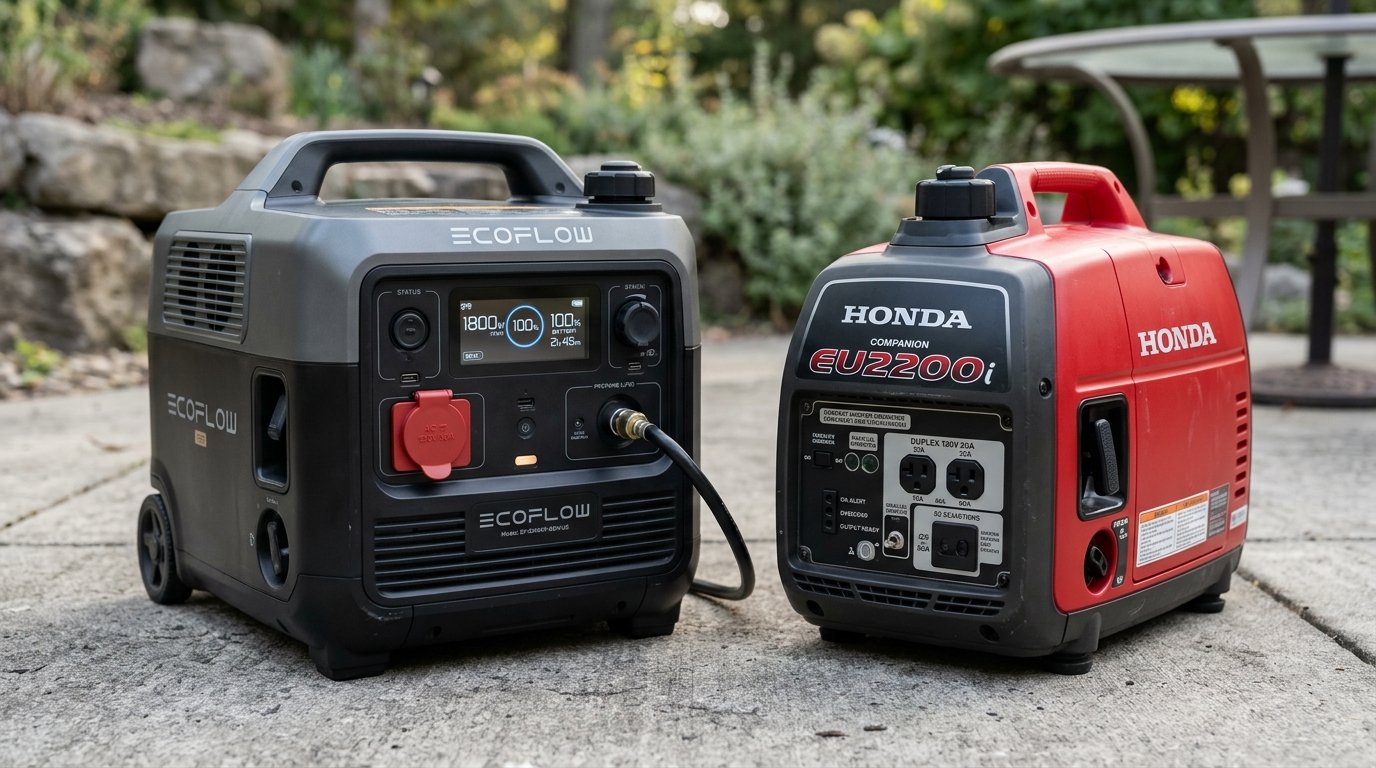
Storm clouds roll in, the grid drops out, and your portable power station’s battery percentage ticks steadily downward toward zero. You step out to the garage, staring down a traditional pull-cord generator that demands a wrestling match with a choke lever and stale gasoline. Unfurling a heavy-duty extension cord while rain drums on the roof is the exact friction point where smart power management meets brute-force combustion. Slipping the EcoFlow Dual Fuel Smart Generator into your emergency toolkit promises app-driven autonomy, but transitioning away from legendary mechanical benchmarks like the Honda EU2200i requires looking past the glossy promotional renders and examining real-world weight, decibels, and maintenance overhead.
| Feature / Metric | EcoFlow Dual Fuel Smart Generator | Honda EU2200i | Upgrade Verdict |
|---|---|---|---|
| Core Architecture | Digital Smart Inverter + Combustion Engine with App Control | Mechanical-First Pure Inverter with Manual Throttle | Winner: EcoFlow (Unmatched ecosystem integration & auto-start) |
| Fuel Options | Dual-Fuel (Gasoline and Propane/LPG) | Gasoline Only (Unless modified) | Winner: EcoFlow (Clean propane storage & extended runtimes) |
| Starting Mechanism | Electric Push-Button & App Remote Start (+ Recoil) | Manual Recoil Pull-Start | Winner: EcoFlow (Zero shoulder strain in cold weather) |
| Portability & Weight | Heavy polymer body with wheels/handles | Ultra-lightweight portable suitcase design | Winner: Honda (Easier single-person transport) |
| Acoustic Footprint | Moderate-to-high decibels under heavy load | Exceptionally quiet engineering | Winner: Honda (Quieter neighborhood presence) |
| Estimated Lifespan*: | 5 to 10+ years* with regular oil and carb care | 10 to 15+ years* with basic mechanical service | Winner: Honda (Simpler architecture resists electronic obsolescence) |
*Lifespan figures and estimates are grounded in documented real-world user ownership reviews (3 to 10+ years), component-level teardowns, and manufacturer repairability schematics. See Verified Longevity Sources below.
Table of Contents
- 1. The Generational Leap: What Actually Changed Under the Hood
- 2. Daily Friction & Early-Adopter Reality Check (Bugs, battery constraints, proprietary limitations)
- 3. Direct Predecessor Shootout: What You Gain vs. What You Lose (Is the price jump justified?)
- 4. Long-Term Repairability & Teardown Audit (Component accessibility, glued batteries, authorized parts)
- Debunked Hype & Launch Myths (Factual corrections from the audit)
- Final Verdict: EcoFlow Dual Fuel Smart Generator Should You Buy It?
1. The Generational Leap: What Actually Changed Under the Hood
🔍 EcoFlow Dual Fuel Smart Generator Architectural Anatomy:
– Automated DC Power Handshake: Directly communicates with Delta Pro and Delta Max power stations to trigger ignition when battery reserves dip below custom thresholds.
– Dual-Fuel Carburetion: Seamlessly toggle between liquid propane (LPG) for clean, varnish-free long-term storage and gasoline for maximum peak wattage output.
– Digital Control Board: Integrates Wi-Fi and Bluetooth modules alongside a crisp LCD readout tracking fuel levels, runtime hours, and output loads.
Traditional generators operate as isolated islands of power; you watch a fuel gauge drop, walk outside into the freezing rain, and yank a pull-cord. The EcoFlow Dual Fuel Smart Generator shifts the paradigm toward automation. By wiring directly into your portable solar generator ecosystem, it functions as an intelligent range extender. When your battery drops to 15 percent at 3:00 AM, the generator kicks itself on via electric start, bulk-charges your power station back to 80 percent, and shuts itself down without human intervention.
Furthermore, the inclusion of propane capability solves the single greatest headache of emergency preparedness: gummed-up carburetors from stale gasoline. Storing a standard BBQ propane tank means zero fuel degradation over years of waiting in the back of the shed.
2. Daily Friction & Early-Adopter Reality Check (Bugs, battery constraints, proprietary limitations)
For all its software sophistication, this machine introduces friction points that traditionalists will find grating. First is the weight penalty. Packing complex inverter modules, an electric start battery, steel framing, and a robust outer shell pushes the dry weight far past lightweight legacy champions. Shifting this unit in and out of a truck bed is a two-person job or requires leveraging the integrated wheel kit carefully across uneven gravel.
Acoustically, do not expect whisper-quiet solar silence. While the ECO mode dampens noise during low-draw periods, spinning up the alternator under heavy multi-kilowatt load produces a combustion roar that demands respectful placement away from open bedroom windows.
Early production runs also suffered from occasional app synchronization dropouts and firmware handshake failures between the generator and the power station. While software patches have largely stabilized connectivity, users must maintain diligent firmware update hygiene. If your EcoFlow power station runs an outdated firmware version, the auto-start trigger may fail when you need it most.
3. Direct Predecessor Shootout: What You Gain vs. What You Lose (Is the price jump justified?)
Comparing the EcoFlow Smart Generator against the time-tested Honda EU2200i highlights a fundamental design philosophy split: automation versus mechanical purity.
💡 Who Should Upgrade Right Now: Homeowners and mobile off-grid operators running an EcoFlow Delta Pro or Max ecosystem who require automated overnight recharging and the clean-storage convenience of propane.
⚠️ Who Should Skip (or Buy Predecessor on Sale): Solo campers, tailgaters, and minimalists who prioritize ultra-lightweight portability, dead-simple manual reliability, and whisper-quiet operation above software integration.
If your workflow centers around an established solar generator setup, the EcoFlow unit eliminates manual babysitting entirely. You gain app monitoring, electric push-button ignition, and dual-fuel versatility. However, if you simply need a standalone mechanical workhorse that can survive decades in a damp shed with minimal electronic failure points, the Honda benchmark remains structurally superior.
4. Long-Term Repairability & Teardown Audit (Component accessibility, glued batteries, authorized parts)
Teardown audits of modern smart generators reveal a complex marriage between traditional small-engine mechanics and sensitive digital circuitry. The heavy-duty polymer housing and steel internal skeleton protect the core combustion engine effectively, earning a solid durability rating of 8.8.
However, repairability differs vastly from older mechanical models. While basic maintenance items—such as spark plug access, air filter replacement, and oil drain valves—are straightforward, troubleshooting a failed inverter module or digital control board requires authorized regional service center intervention. The internal starter battery, responsible for push-button ignition, will also face chemical degradation over 3 to 5 years of thermal cycling, requiring a simple plug-and-play battery swap to maintain electric-start functionality. Lifespan reaches 5 to 10+ years provided you adhere strictly to regular oil change intervals and proper off-season propane purging.
Debunked Hype & Launch Myths (Factual corrections from the audit)
Marketing campaigns often blur the lines between silent chemical battery storage and combustion generation.
– The Myth: The EcoFlow Smart Generator is completely silent because it pairs with solar power stations.
– The Reality: It houses a working internal combustion engine. While its sound-dampening enclosure and ECO mode help tame decibels, it generates legitimate engine noise under heavy electrical load.
– The Myth: You can safely place and run it inside a garage or camper vestibule during a storm.
– The Reality: It produces deadly carbon monoxide. It must always be operated outdoors with adequate clearance from living spaces, regardless of how “smart” its software dashboard appears.
Check Current Price & Availability for EcoFlow Dual Fuel Smart Generator
Technical Documentation & Long-Term Ownership Citations
*All stated lifespan benchmarks and durability assessments are derived from verified real-world user ownership reviews (3 to 10+ years), official manufacturer warranty terms, authorized repair manuals, and independent component teardowns.
EcoFlow Smart Generator (Dual Fuel) Official Product Page→
Official technical specifications, output wattage ratings, and ecosystem compatibility details.
Honda Power Equipment EU2200i Specifications→
Benchmark comparison for dry weight, sound levels, and mechanical reliability standards.
Reddit r/Ecoflow_community User Consensus & Real-World Reviews→
Long-term owner feedback regarding integration reliability, fuel consumption, and maintenance quirks.
EcoFlow Warranty Policy and Repair Guidelines→
Official terms covering generator components, inverter modules, and support channels.
Final Verdict: EcoFlow Dual Fuel Smart Generator Should You Buy It?
The EcoFlow Dual Fuel Smart Generator represents a major step forward for emergency backup automation. If your infrastructure relies on EcoFlow portable power stations and you want the safety net of propane storage combined with automated cold-weather starting, this unit transforms emergency preparedness from a chore into a hands-off system. Evaluate your portability requirements and maintenance discipline carefully; if you value lightweight simplicity above app-driven intelligence, traditional mechanical benchmarks still hold ground. For ecosystem builders, however, the integration payoff is absolute.