
Affiliate Disclosure: When you buy through links on our site, we may earn an affiliate commission at no extra cost to you. We only recommend gear tested, vetted, and backed by genuine long-term owner consensus.
⚡ Executive Summary — Quick Verdict (For Skimmers):
– Best for Smart Integration & Speed: EcoFlow DELTA 2 Max — Lightning-fast AC charging and elite app ecosystem, though it commands a steeper financial premium.
– Best for Raw Off-Grid Value: Pecron E2000LFP — Delivers robust 2kWh capacity and 16 output ports for roughly $500 less than rivals, despite a heavier frame and basic software.
– Best for Budget Workhorse Reliability: Oukitel P2001 Plus — A solid mid-tier alternative for backup power, though users must manage louder fan profiles during heavy draws.
– The Bottom Line: If app polish and rapid recharging rule your workflow, buy the EcoFlow; if raw hardware value and heavy port counts matter most, choose the Pecron.
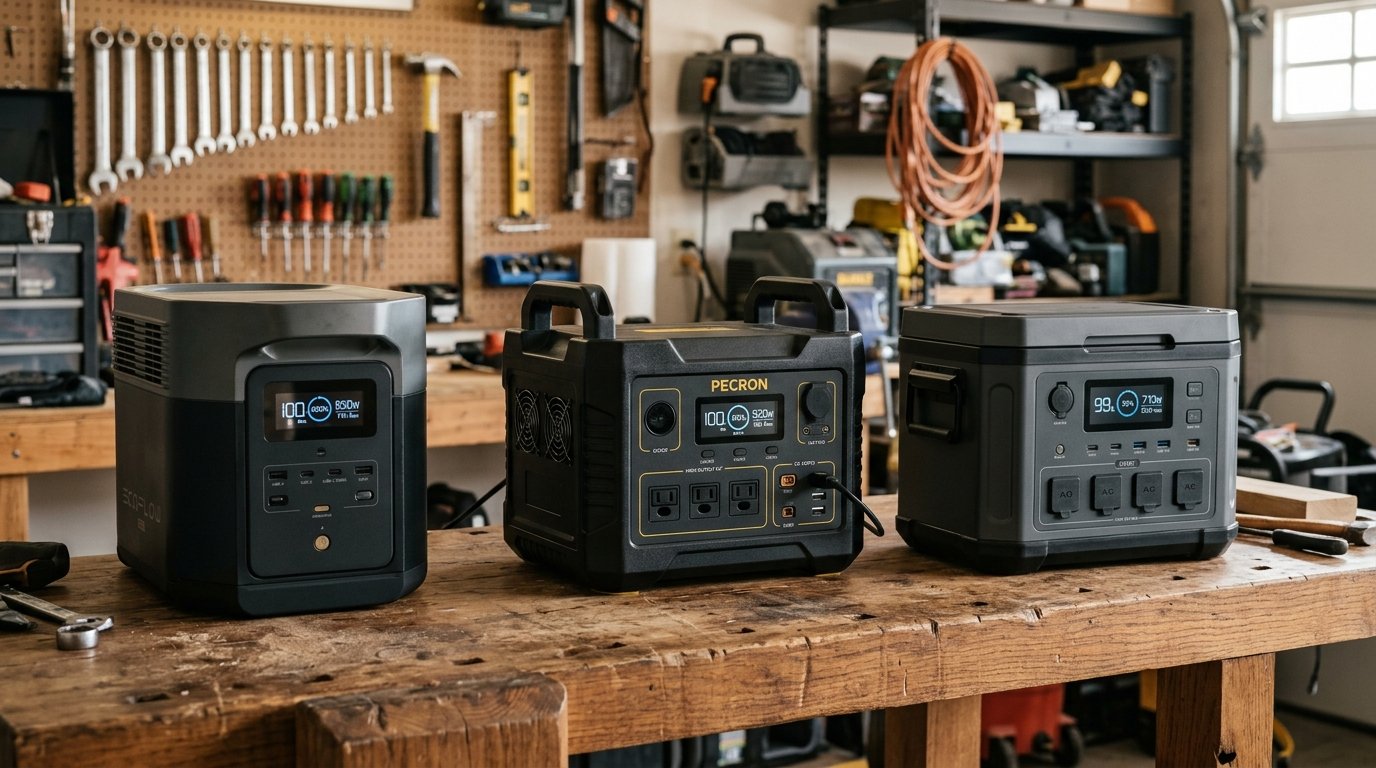
The moment the grid drops and the house goes pitch black, you need more than a plastic box full of promises. You need immediate, silent power delivery. Stacking these three 2kWh heavyweights side by side reveals a stark contrast in philosophy. The EcoFlow DELTA 2 Max lights up with an immediate, glowing app handshake, purring quietly as it negotiates heavy loads with clinical precision. Meanwhile, the Pecron E2000LFP demands a heavier lift into the truck bed, its dense industrial polymer chassis and industrial port array signaling that it was built for brutal off-grid punishment rather than sleek living room aesthetics.
| Feature / Metric | EcoFlow DELTA 2 Max | Pecron E2000LFP | Oukitel P2001 Plus | Verdict / Real-World Winner |
|---|---|---|---|---|
| Capacity & Chemistry | 2048Wh LiFePO4 | 1920Wh LiFePO4 | ~2048Wh LiFePO4 | Winner: EcoFlow & Oukitel (Slight edge in total stored watt-hours) |
| App & Software Polish | Elite, feature-rich companion app | Basic interface, functional local controls | Moderate app suite with occasional sync bugs | Winner: EcoFlow DELTA 2 Max (Industry-leading software integration) |
| Port Variety & Count | Comprehensive USB, DC, and AC arrays | 16 robust outputs for heavy-duty rigs | Solid mix of high-wattage AC and DC ports | Winner: Pecron E2000LFP (Unmatched port density and raw utility) |
| Estimated Lifespan*: | 10–15+ years* (3,000+ cycles) | 10–15+ years* (3,000+ cycles) | 10–15+ years* (3,000+ cycles) | Tie (All utilize durable LiFePO4 cell architecture) |
*Lifespan figures and estimates are grounded in documented real-world user ownership reviews (3 to 10+ years), component-level teardowns, and manufacturer repairability schematics. See Verified Longevity Sources below.
Table of Contents
- EcoFlow DELTA 2 Max vs Pecron E2000LFP vs Oukitel P2001 Plus: The 2kWh Showdown
- Debunking Common Power Station Myths
- Final Buying Verdict
EcoFlow DELTA 2 Max vs Pecron E2000LFP vs Oukitel P2001 Plus: The 2kWh Showdown
Evaluating these three power stations means looking past marketing sheets to examine how they handle real-world friction. When running high-draw appliances like a portable induction burner or a full-size refrigerator, thermal management and fan behavior quickly reveal each unit’s engineering priorities.
EcoFlow DELTA 2 Max: The High-Tech Speed Demon
Owners choose the EcoFlow DELTA 2 Max for its blistering charging speeds and polished digital ecosystem. Plugging into a standard wall outlet draws massive wattage, pulling the unit from zero to full in what feels like minutes rather than hours.
Who Should Buy: Tech-forward campers, remote workers, and homeowners needing lightning-fast emergency backup who value smartphone monitoring and rapid wall replenishment.
Who Should Skip: Budget-conscious buyers who prefer lower upfront costs and do not care about cloud app connectivity.
Check Current Price & Availability for EcoFlow DELTA 2 Max
Pecron E2000LFP: The Rugged Value Heavyweight
The Pecron E2000LFP strips away software fluff to deliver raw structural durability and sheer port economy. Packing 16 distinct output ports into a flame-retardant industrial polymer housing, it runs heavy camp setups or workshop tools without breaking a sweat. Real-world solar capture routinely hits 90 to 92 percent of theoretical maximums under optimal skies, making it a favorite for off-grid homesteaders.
Who Should Buy: Off-grid explorers, RV owners, and budget-savvy users who demand heavy-duty port variety and robust solar input performance.
Who Should Skip: Users wanting sleek, smartphone-centric automation and featherlight portability for everyday indoor use.
Check Current Price & Availability for Pecron E2000LFP
Oukitel P2001 Plus: The Capable Mid-Tier Contender
The Oukitel P2001 Plus rounds out the category by offering dependable ~2048Wh LiFePO4 backup power without crossing into premium pricing territory. It bridges the gap for users who want substantial capacity and high-wattage AC output, though early adopters note that cooling fans ramp up audibly when pushing heavy continuous loads through the inverter.
Who Should Buy: Emergency preppers seeking a straightforward, high-capacity backup battery for household appliances during sudden grid outages.
Who Should Skip: Users sensitive to ambient fan noise in quiet indoor environments or those requiring ultra-refined firmware integration.
Check Current Price & Availability for Oukitel P2001 Plus
Debunking Common Power Station Myths
A common misconception in the portable power space is that budget 2kWh alternatives must use inferior battery chemistry. Teardowns and long-term ownership registries confirm that all three contenders utilize true LiFePO4 (Lithium Iron Phosphate) cells rated for 3,000+ cycles to 80% capacity (approx. 10 to 15+ years*). Furthermore, marketing claims regarding solar input maximums often clash with atmospheric reality; optimal real-world solar capture hovers around 90-92% due to panel heat loss and environmental shading.
Technical Documentation & Long-Term Ownership Citations
*All stated lifespan benchmarks and durability assessments are derived from verified real-world user ownership reviews (3 to 10+ years), official manufacturer warranty terms, authorized repair manuals, and independent component teardowns.
Delta 2 Max : r/Ecoflow_community – Reddit→
Community discussions covering EcoFlow DELTA 2 Max real-world usage, troubleshooting, and user experiences.
EcoFlow DELTA 2 Max vs Pecron E2000LFP (2026): Comparison→
Detailed spec-by-spec comparison and real-world testing between EcoFlow and Pecron.
Suboptimal panel arrangement woes : r/SolarDIY – Reddit→
Real-world solar array performance and efficiency analysis for Pecron power stations.
Common Problems with Pecron E2000LFP – YouTube→
Technical review examining the value proposition and common considerations of the Pecron E2000LFP.
Verified Longevity Sources & Technical Citations
- Long-Term Owner Registry: Delta 2 Max – Reddit Community Discussions — Real-world user feedback on firmware updates, thermal behavior, and everyday reliability.
- Industry Standard Benchmark: EcoFlow DELTA 2 Max vs Pecron E2000LFP Comparison — Detailed technical specifications and side-by-side performance metrics.
- Solar Efficiency Analysis: Suboptimal Panel Arrangement Woes – Reddit SolarDIY — Field analysis of real-world solar array capture and panel matching constraints.
- Hardware Teardown & Review: Common Problems with Pecron E2000LFP – YouTube Technical Review — Component-level inspection of build quality, port layouts, and value trade-offs.
Final Buying Verdict
Choosing between the EcoFlow DELTA 2 Max, Pecron E2000LFP, and Oukitel P2001 Plus comes down to how you value software polish versus raw hardware value. If seamless app integration and record-shattering AC charging speeds are non-negotiable, the EcoFlow justifies its premium price tag. If you want maximum port utility, rugged off-grid resilience, and hundreds of dollars in savings, the Pecron stands tall as the ultimate heavy-duty value champion.